Posted by: nik | January 28, 2013

house cleaning

I’m not going to lie to you, our house is pretty cluttered. Before we have company over we always have to spend the better part of day putting things away, dusting, scrubbing, mopping, etc., etc. It’s not that I don’t like a clean house. I always feel much more comfortable when things are tidy, but I guess it’s just a matter of priorities. But there is one type of house cleaning that I get really excited about. Cleaning off the top of our house! Why? Because that’s where we keep our power plant!

It’s snowing today but this past week saw a string of five brilliantly sunny days in a row. If you don’t live in the northeast, you might not be able to appreciate the significance here, but take my word for it, that’s a big deal. Sun in January in Vermont goes a long way, especially if you get your energy from the sun. And I get both my psychic energy and my electric energy from the sun.

The forecast for Saturday called for cold temperatures and lots of sun–ideal conditions for solar power production! It might be counter-intuitive but solar electric panels actually operate more efficiently when it is very cold out. The output voltage increases as the cell temperature decreases.  This is a result of the semiconductor effect and the same reason we have cooling fans blowing across the processor chips in our desktop and laptop computers. The days are much shorter this time of year and sunny days are few and far between, but we will often see the highest power readings during the cold months of January and February. This is primarily a function of low moisture content in the air, but also the temperature coefficient of the solar cell can have a significant effect.

So I woke up Saturday morning to a bright sunny day looking forward to spinning our electric meter backwards, a rare occasion this time of year. I looked out the window and was discouraged to see that we had received a light dusting of snow Friday night, only about an inch or so but that’s plenty to totally shut down the power plant on the roof. Not to worry though, Li Ling the Fearless, was on the job!
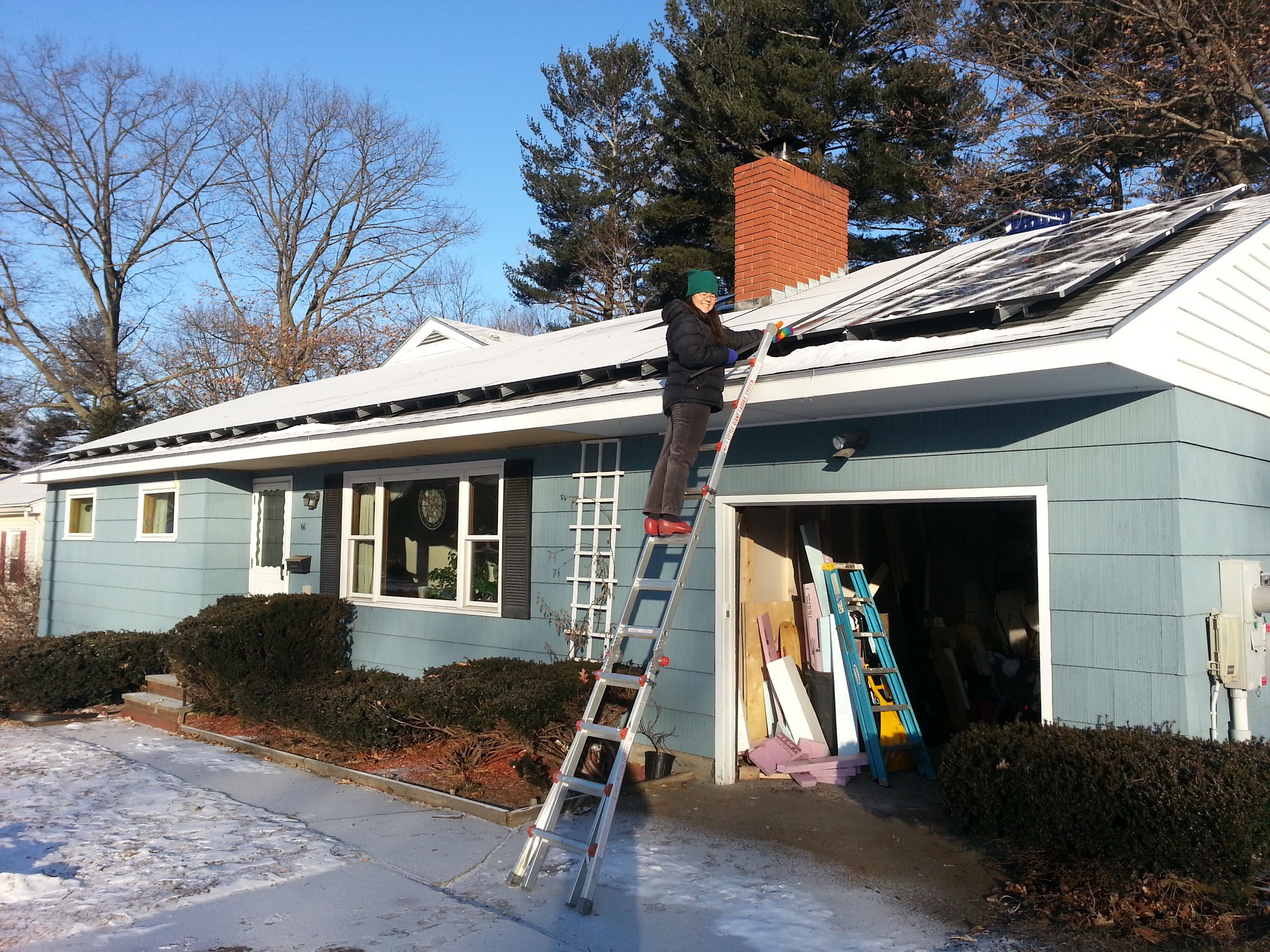
House cleaning!

Li Ling clearing the snow off our solar panels with a plastic roof rake. 8:40 AM

She got out the extension ladder and the telescoping roof rake before I even had my long johns on. The plastic roof rakes does a decent job but, as you can see in the photos, it’s not 100%. There are little bolts that stick up in between each solar module. The roof rake catches on these and you have to maneuver around them leaving some snow behind. When it’s warm outside (above freezing) the snow will just melt off, no problem. But remember, the forecast was for cold, damn cold!

Here’s the photo our daughter posted on facebook earlier in the week:

cold, cold, cold, cold, cold

Screen capture from the national weather service website. All temperatures are in Fahrenheit.

So I wasn’t sure if the modules would warm up enough throughout the day to melt the small amount of snow that was left behind. This was a bit of an experiment so I decided to take photos every half hour until the panels were totally clear.

Here they are at 9:00 AM (immediately after raking is complete.)
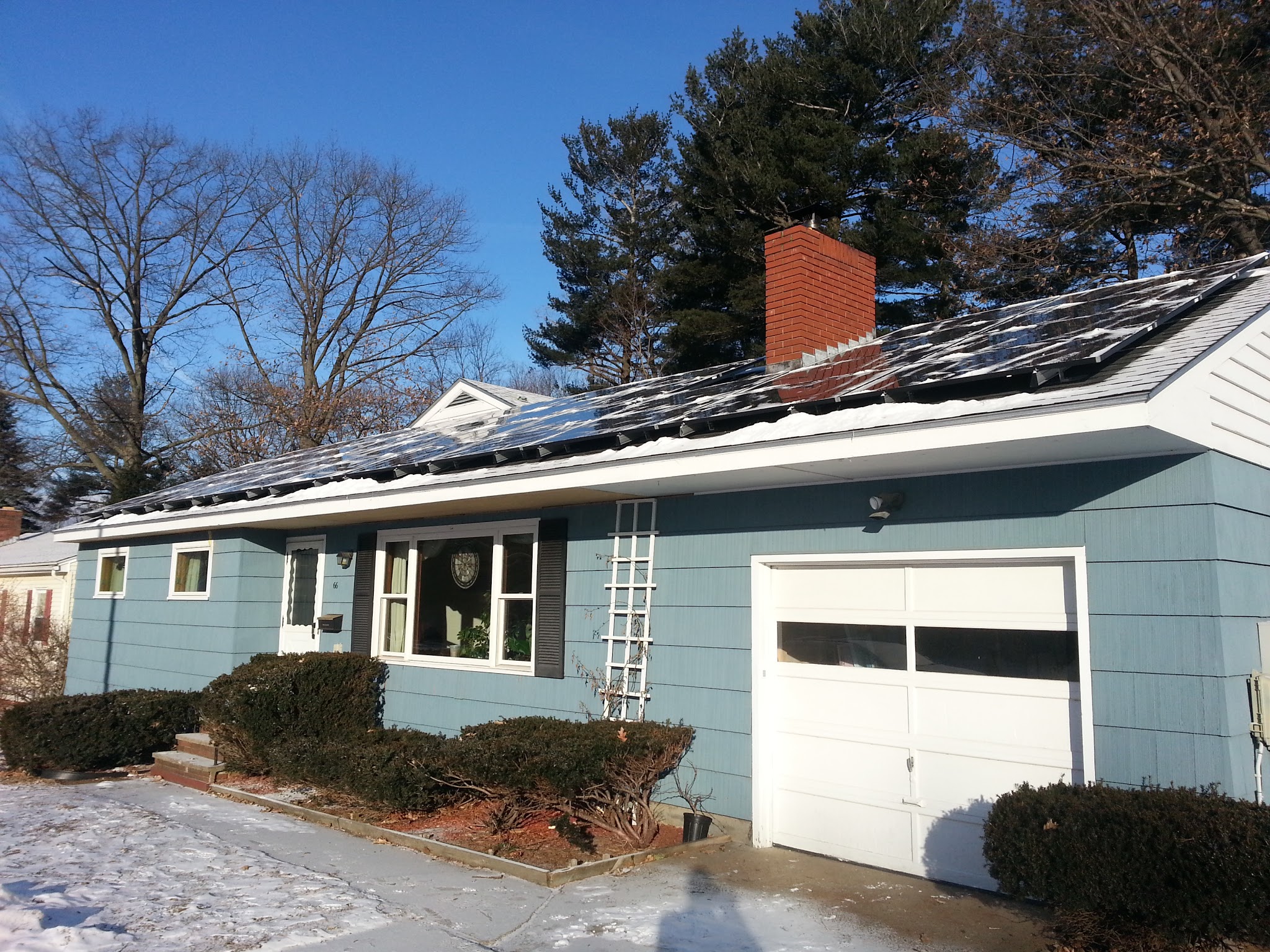
The roof at 9:00 AM

The roof at 9:00 AM, 0 degrees F, 3000 Watts

According to our online data monitor, at this point our solar system was producing 3,000 watts (30% of the peak capacity.) Keep in mind that this is still very early in the morning (for a Saturday at least) and the sun is only glancing across the front of the modules from low on the horizon.

So the question remained, could we recover in these frigid temperatures?

I took some garbage to the dump. Got another coffee and warmed up by the woodstove. I went back out at 9:30 and little had changed. Here’s the photo.

By 10AM there was a noticeable amount of melting happening and by 10:49AM the snow had totally melted. Here’s the photo:

Clear roof! 10:49AM, -2 degrees, 7kW

Clear roof! 10:49AM, 8 Degrees Above Zero, 7,000 Watts!

The high temperature of the day was only 14 degrees Fahrenheit (-10 C for those of you in the developed world.) But even though the air temperature never got above freezing, the solar panels warmed up enough in the January sun to melt the snow off by 11am. We generated over 31 kilowatt-hours for the day! That’s about 200% of what we normally use. The meter was definitely spinning backwards. I would call it a wildly successful experiment and a very rewarding one too. This is the type of housecleaning that really pays off!
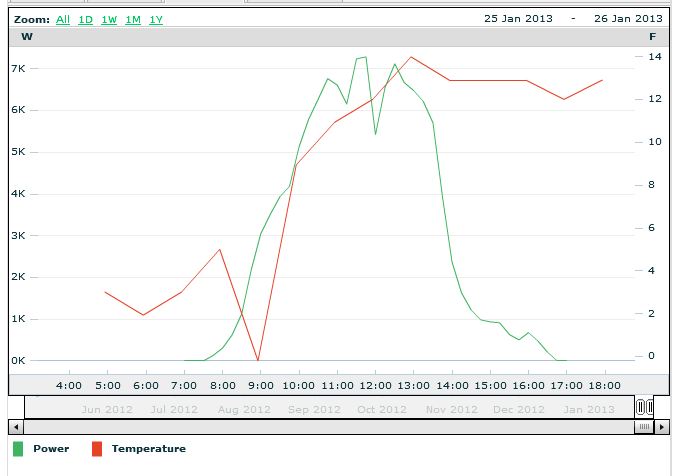
Solar power output on left scale, temperatures on right

January 26, 2013; Solar power output in Watts on left scale, temperatures on right
Posted by: Li Ling Young | January 27, 2013

Don’t Insulate Your Hot Water Pipes

Electric hot water is expensive.  We’ve installed low flow shower heads.  We have a water efficient clothes washer.  But after that we’re almost at the end of what we can do to save water heating energy through conservation.  A quick, uncareful guess at our hot water consumption is about 50 gallons per day: 10 gallons each for 3 showers, 10 gallons every other day for the dishwasher, 10 gallons at the kitchen sink, a few gallons at the bathroom sink and a few gallons for laundry.

Here comes the math…  Raising that much water 70 degrees (from 50 degrees at the inlet to 120 degrees in the tank) takes  8.2 kWh/day.  We pay 14.5 cents per kWh, so over the course of a month that’s $36.  After we installed our heat pump water heater we more than cut that in half, but that’s a story for another post.

It’s common that folks trying to save energy on their water heating will ask whether insulating the hot water pipes is a good idea.  Losing heat through the pipes is like losing heat out of the house, right?  So keeping the heat in the pipes will use less water heating fuel, right?  My answer is “No” and here’s why.

Hot water is stored in a tank.  The tank is insulated, and unless you have a very old water heater, it’s probably insulated pretty well.  Electric water heaters in particular can have great tank insulation.  If your tank is enormous, has a plastic shell and is domed on top you’ve got good insulation.  Gas water heaters tend to not have such good insulation.  I do think it’s a good idea to insulate any water heater tank that came with fiberglass insulation.  Do a good job detailing the tank wrap, and insulate the top of the tank too.  With gas water heaters, adding tank insulation must be done carefully because there’s a fire inside the tank and you have to be careful not to block the combustion air intake or get too close to the flue pipe, which is hot and can catch your tank wrap on fire.  One of Nik’s friends was nearly killed by carbon monoxide poisoning when the water heater tank insulation caught fire behind the wrap and smoldered just enough to make carbon monoxide but not enough to trigger the smoke detector.  Insulate a gas tank knowledgeably and carefully or not at all.

On the other hand, hot water is not stored in the pipes.  Hot water goes in the pipes, and the hot water that gets left behind cools off eventually, but no fuel is burned keeping that water hot.  Keeping the  water in the pipes hot all the time would be nice.  That way there would be hot water at the tap all the time.  But don’t confuse instant hot water with energy conservation.  In fact, the devices that ensure hot water at the tap are energy porkers.  In hotels where you can have a shower hundreds of feet from the water heater, and in big houses where people just feel entitled to hot water at a moments notice, hot water is continuously circulated out of the tank through a pipe loop that goes on a tour of the sinks and showers.  That uses pumping energy, and continuously refreshing the hot water in the pipes means continuous heat loss out of the pipes, which causes the water heater to use a lot of fuel keeping itself and the water in the pipes hot.  In this case, yes it is a very good idea to insulate the pipes.  But insulation is only helpful so long as the hot water in the pipes keeps getting refreshed, and besides, very few people need instant hot water so desperately they’d do this kind of boneheaded system in their house.

Which brings us to pipe insulation and what it can and can’t do.  Insulation does not make heat.  And insulation does not keep something hot (or cold).  Insulation SLOWS heat transfer.  Given enough time, the stuff on one side of the insulation (water) will become the same temperature as the stuff on the other side (the air in your basement), if there is no additional input of energy.  And there’s the rub: water in pipes is not heated; only the water in the tank is heated.  Insulating something only makes sense if you’re going to actively keep it at a different temperature from the stuff around it.  So insulate the tank, and read on for ways to minimize heat loss through the pipes (none of which involves insulating the pipes.)

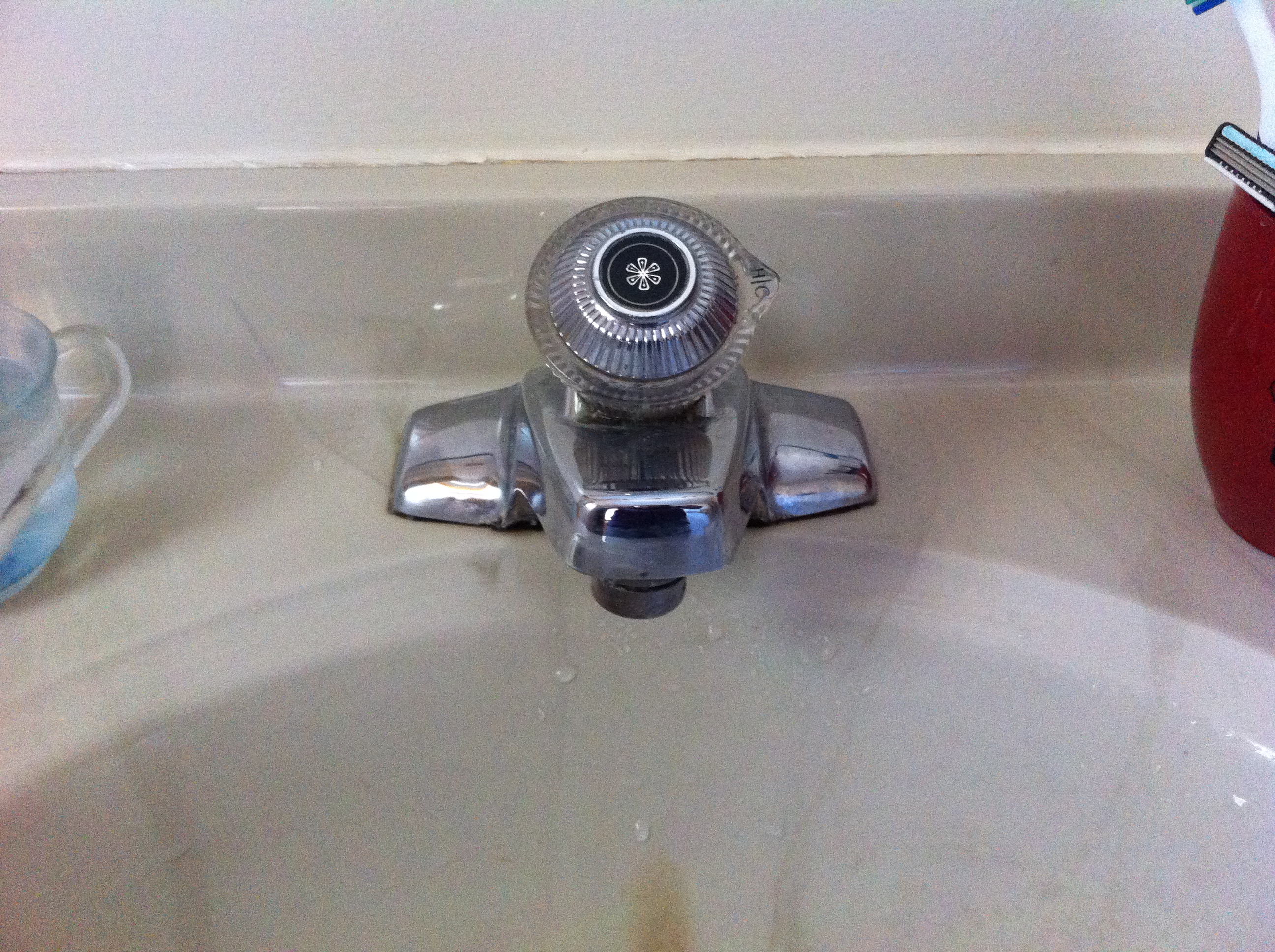
tap on cold side

Keep the tap turned to the cold side all the time.

When there is a short water draw hot water is not drawn out of the water heater.

When there is a short water draw hot water is not drawn out of the water heater.

Most water draws are too short for the hot water to arrive at the sink.  Don't put hot water in the pipe for no reason.

Most water draws are too short for the hot water to arrive at the sink. Don’t put hot water in the pipe for no reason.

Losing heat out of the pipes is a bummer.  It’s just wasteful and bothers me as a conservationist.  Here’s the main thing I do to prevent hot water from sitting in the pipes and losing heat to the basement: I keep the hot water out of the pipe.  In actuality, most of the water draws in the home  are short: a quick hand wash, wetting a cloth, rinsing the crumbs off the cutting board, etc.  In these cases no one, certainly not I, leaves the tap on long enough for hot water to get to the tap.  If we used the hot water recently so the water in the pipe is still hot, perhaps we’re glad to have hot water for these little squirts.  But usually we’re ok with cool water.  If the tap is on the hot side when we draw a little bit of water a slug of hot water goes in the pipe even though we didn’t use hot water.  An hour later, when we use another little bit of hot water, that water has cooled off but we don’t notice because we only run the water for a couple of seconds and we weren’t really expecting the hot water to get to the tap anyway.  Another slug of hot water gets introduced into the pipe.  Having insulation on the pipes would not change this one bit.  The water in the pipe will cool off whether or not it’s insulated, and usually we don’t use the hot water soon enough to prevent this.  The solution: keep the taps turned over to the cold side.  I keep all the taps in the house on the cold side unless I’m at the sink for a long time doing something that needs hot water, like washing dishes or taking a shower.  I don’t wait for the hot water to get to the tap.  When I need hot water, I use it; when I don’t need hot water I don’t unintentionally fill the pipe with hot water.

The amount of hot water that is left behind in the pipe when you use hot water is a function of how big the pipe is and how far it is from the water heater to the tap.  In new construction there are codes that limit how big the pipe can be.  I think this is actually for water conservation (since a lot of water just goes down the drain while you’re waiting for the hot water to arrive) rather than energy conservation, but it’s good for both.  In addition to correctly sizing the pipe, the  pipe layout can be configured for low water volume between the tank and the tap.  And finally, when designing a house the bathrooms and kitchen can be located back-to-back and on top of one another, with the water tank immediately below, thus keeping all hot water pipes short.  If you should ever have to replace any of your hot water pipes, consider including one of these strategies for saving water and water-heating energy.  Since a water heater is replaced many times in the life of a house, that’s a great time to incorporate efficiency upgrades.

And to wrap it all up, back to the pipe insulation…  There is one part of the hot water pipes that should always be insulated.  Hot water in the tank often floats into the pipes when hot water isn’t being used.  This is a result of poor design in American water heaters.  With the pipes attached to the top of the tank, hot water in the tank moves up into the pipes by thermosiphon.  Some tanks have a doodad called a heat trap that prevents this, but some tanks don’t and anyway I think the heat traps might not always work.  Thermosiphoning is a pretty weak force and generally doesn’t move hot water past the first elbow in the pipe.  Insulate the pipe ON BOTH THE HOT AND COLD SIDE within a couple of feet of the tank.  Detail the pipe insulation carefully around fittings and elbows; tape the insulation in place if it isn’t the kind that has adhesive on the meeting edges.  Be careful with gas water heaters: sometimes the pipes are right next to the flue pipe and any insulation would be exposed to extremely high temperatures (don’t insulate in this situation).  Remember, this is to prevent your water heater from wasting energy, not to give you instant hot water at the tap.  If that’s what you want, look for a future post on demand recirculators.

If you really want to insulate your pipes, go for it.  But do it knowing that it won’t prevent frozen pipes and it won’t save energy.

Posted by: nik | October 9, 2012

Freakshow defined

We have a heat pump water heater. There is a compressor with a phase-change fluid on top of an 80-gallon tank. It extracts energy from the air in the basement to heat our domestic water. It works great and only uses about 1 kilowatt-hour per day (1/3 of  the energy that our old electric water heater  used.)

The efficiency of the heater is a function of the air temperature around it. We’re both energy geeks (if you hadn’t figured it out yet) so we’re always looking ways to squeeze out a little more performance from our gizmos. Recently Li Ling has started to pull the dryer vent off the wall to vent the warm exhaust directly into the basement.

image

This is quintessential “energy freakshow” material.

« Newer Posts - Older Posts »

Categories