Posted by: Li Ling Young | October 3, 2012

Precious Water

When we moved in to our new house the showerheads, like the lightbulbs, were something from a previous era.  Taking a shower felt wonderful, and rinsing my hair was like standing under a waterfall.  My guess is the showerheads gushed between 4 and 5 gallons per minute.  That’s twice the flow of any showerhead you can legally buy in the US.  It couldn’t last.

When we moved in to our new house the water in the kitchen sink would ricochet off our hands and get us wet around the tummy.  It was hard to modulate the flow of water.  The sprayer was so powerful it vaporized the water into a fine, Niagara Falls-type fog.  The kitchen faucet was very unpopular.

When we moved in to our new house we suddenly had twice as many bathrooms as we’d ever had before.  We needed two shower curtains, two bars of hand soap, two floss dispensers, more towels, and  there were two toilets to think about.  Toilets really do take some thinking-about.  One, they have to work, and by this I do not mean that it makes a swooshing noise when you press the lever, and stops running the water when the tank is full.  No, I mean the flushing has to be effective.  Two, the toilet can’t use as much water as a quick shower to do the job.  This may not seem like a basic toilet function, but it is.  They’re just not allowed to be water hogs.  Our toilets were water hogs: at least 5 gallons per flush.

I kind of like finding houses like this one, where there have been no energy upgrades, ever.  You can really make a big difference in homes like this, and usually pretty easily.  We replaced some stuff and installed something new; probably we’re using  30% less water than we would be using if we hadn’t changed anything.  But, really that’s not enough.  We haven’t changed some important things, and our water use should be another 25% lower than it is.

Whenever you’re trying to reduce your consumption it’s useful to know what your big consumers are before you make any big changes.  Otherwise, it’s kind of like going on a diet by swearing off liver pate.  If all you ever eat is french fries and jelly beans, cutting out the pate will do nothing for you.  Here’s a quickie on where the average American family’s water gets used.
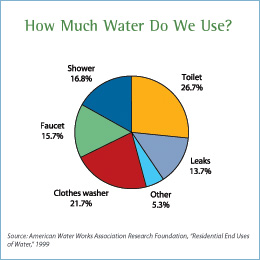
Pie chart showing where water is used in the house

Big water uses like toilets should be the first target of water conservation efforts.

We don’t water our lawn, but in some parts of the country, outdoor water use adds 50% to the daily water consumption.  Daily water for a family our size is generally 300-400 gallons per day.  Yikes!

So, save water by focusing on toilets, showers and clothes washing.  Leaks are avoidable and 100% waste.  Zero tolerance on leaks.

Our clothes washer is highly energy- and water-efficient, so our first step was to replace the showerheads with 1.5 gallon-per-minute handheld models.  I like the handheld models because it’s easier to clean the tub and the dog.  But I never give the dog a bath and very rarely scrub the tub, so that whole handheld thing is pure delusion.  I just wanted you to know that handheld showerheads come in low-flow versions.  Are they as wonderful as the showerheads we got rid of?  Hell no.  It takes me about three hours to rinse my hair, and when it’s cold out the shower makes me colder instead of warmer.  But we’re all pretty well used to them by now, and when I think about the showers I’ve had in foreign countries I figure anything more luxurious than our 4-hole high velocity drip is pure American privilege.

Next we put a pressure reducer on the house water supply.  Nicholas measured the water pressure and it was twice what it should be.  That explains the splashing water in the kitchen sink, and why both tub faucets leaked (high water pressure wears out valves).  Now our water pressure is 50 psi.  Everybody is ok with the kitchen faucet; it’s easy to control the flow rate and it doesn’t splash.  Nicholas replaced the tub faucets with pressure-balancing ones, which took care of the leaks and fixed the problem with the shower going cold when someone uses water somewhere else in the house.

We’ve got a couple of Freakshow things going on with our water use…  I use the water from the dehumidifier in the house plants, and Nicholas keeps a bucket next to the shower for collecting the discard water that comes before the shower runs hot.  That makes up about one flush a day.
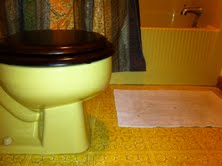
Yellow bathroom

Our toilet probably flushes 5 gallons. But it matches our floor, so I like it.

And that brings us to the toilets and my yellow bathroom.  My best guess for when the addition was built is right around 1980.  I base that mostly on the style of the bathroom, but also on the siding and electrical.  We have a yellow tub, yellow vinyl floor, a yellow toilet and a yellow curtain that came with the house.  We bought yellow towels to go in that bathroom.  I can’t get rid of our toilet; it goes with the room.  And yet, every time we flush we’re using  five- to eight-times as much water as a water efficient toilet uses.  If as a family we flush 16 times a day, that’s 23,300 gallons a year wasted.  At our municipal water rate of $8.77 per  CCF (that’s 100 cubic feet; and you thought studying roman numerals was a waste of time!) we stand to save $273/year.  Dag, that’s a one year payback on a new toilet.  Do you think I can still get one in yellow?

Epilogue

We happened to be in DC on the 20th anniversary of Earth Day a few years ago.  On the Mall there was a big fair of environmental-themed tents.  The kids’ favorite was a tent for the Avatar movie.  They stood in line for about 2 hours to get painted like a Na’vi.  My favorite display was in the EPA tent where they had a demonstration of how they measure the flush effectiveness of toilets ( MaP testing).  The testing involves little condom-type things filled with 350 grams of soybean paste.  An approved toilet needs to flush at least 350 grams.  The best toilets flush 1000 grams.  Whoa!
Posted by: nik | September 30, 2012

Busted: the sad story of a CFL disaster

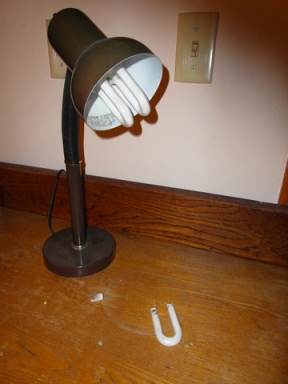
This tubular-type compact fluorescent bulb meet its untimely demise

Previous visitors to our blog may remember the post about our lighting choices.  I was reminded this weekend that my least favorite thing about CFL light bulbs is that they contain mercury, a toxic element know to cause brain damage (Mad Hatter disease) but also kidney and lung disease in humans, not to mention the effects on the environment. Granted, each CFL bulb only contains a very small amount of mercury (about 4 milligrams) but that is still a toxic substance that I would prefer not to have released into my bedroom. Unfortunately, that is exactly what happened this past weekend.

This desk lamp is obviously top-heavy and easy to knock over. I should have known better than to put a long CFL bulb in it, but, as they say, live and learn. As I was hurrying around this past weekend I accidentally knocked the lamp over, instantly breaking the bulb. Luckily, no one was hurt and the mess was contained to the top of the dresser, making for a relatively easy clean-up.

Hopefully, since you’re reading this, you won’t have to make the same mistakes. But if you do happen to bust a CFL bulb, here’s the proper clean up procedure, as according to the EPA:

Before Cleanup

  • Have people and pets leave the room.
  • Air out the room for 5-10 minutes by opening a window or door to the outdoor environment.
  • Shut off the central forced air heating/air-conditioning system, if you have one.
  • Collect materials needed to clean up broken bulb:
    • stiff paper or cardboard;
    • sticky tape;
    • damp paper towels or disposable wet wipes (for hard surfaces); and
    • a glass jar with a metal lid or a sealable plastic bag.

During Cleanup

  • DO NOT VACUUM.  Vacuuming is not recommended unless broken glass remains after all other cleanup steps have been taken.  Vacuuming could spread mercury-containing powder or mercury vapor.
  • Be thorough in collecting broken glass and visible powder.  Scoop up glass fragments and powder using stiff paper or cardboard.  Use sticky tape, such as duct tape, to pick up any remaining small glass fragments and powder. Place the used tape in the glass jar or plastic bag.  See the detailed cleanup instructions for more information, and for differences in cleaning up hard surfaces versus carpeting or rugs.
  • Place cleanup materials in a sealable container.

After Cleanup

  • Promptly place all bulb debris and cleanup materials, including vacuum cleaner bags, outdoors in a trash container or protected area until materials can be disposed of.  Avoid leaving any bulb fragments or cleanup materials indoors.
  • Next, check with your local government about disposal requirements in your area, because some localities require fluorescent bulbs (broken or unbroken) be taken to a local recycling center. If there is no such requirement in your area, you can dispose of the materials with your household trash.
  • If practical, continue to air out the room where the bulb was broken and leave the heating/air conditioning system shut off for several hours.

So I cleaned up the busted bulb and put it out in the garage with the rest of our hazardous waste (rechargeable batteries, etc.) to await the next dump day.

While we’re on the topic, the EPA also published the following chart.

Here’s what it says in English: “Incandescent bad. CFL bulb less bad.”

Here in the US, we are dumping over 100 metric TONS of mercury into the atmosphere every year! As it turns out, the single largest contributor to mercury emissions is coal-fired electric power plants. So, unless we are operating totally offgrid, we can draw a direct correlation from our electrical usage to mercury emissions. The more electricity we use, the more pollution gets dumped into the atmosphere. And opposite is also true: by using less electricity, pollution goes down.

Ironic, isn’t it? The CFL that contains mercury is actually reducing mercury emissions in the long run by operating more efficiently than the incandescent counterpart. Let’s just try to keep the mercury inside the CFL for now. At least until we upgrade to a LED bulb….

Posted by: Li Ling Young | September 30, 2012

Energy and Water

Before I talk about our water conservation efforts it’s important to lay out the connection between water and energy.  Water is what makes life possible on this planet, and for that reason alone we all should do everything we can to use it sparingly and wisely.  However, the world’s dominant way of making electricity also uses water: a lot of it.  So, using grid electricity sparingly is critical to preserve Earth’s lifeblood.

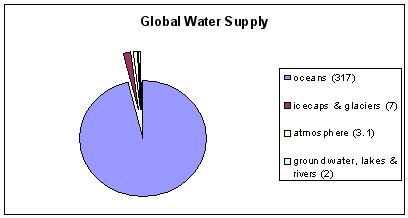
How much fresh water is there?

Only a small fraction on Earth’s water is fresh and life-sustaining for us humans. Of that, only some of it is accessible. Wasting water is a crime against humankind.

On the other side of the coin, processing and transporting clean water uses electricity: a lot of it.  Conserving water makes it more available for fish, farmers and your neighbor, but it also reduces the pollution associated with mining, transporting and burning fuel to make electricity.  If you could have avoided the Deepwater Horizon disaster by letting the yellow mellow, would you have done it?

Since this post is all about perspective, here’s some information about the scale of water and electricity consumption in the energy and water industries.

  1.  The amount of water used in our country’s power plants is four times the amount used for all household purposes.  That’s 400%.  You want to save water?  Use less electricity!
  2. Water shortages have already affected some power plants.  Conflicts between people, agriculture, animals and electricity generation are inevitable.
  3. A lot of the water used in power plants is discharged, but high discharge water temperatures harm wildlife and ecosystems.
  4. Worldwide, water transportation and treatment is 7% of total energy consumption: including transportation and industrial energy!
  5. Some kinds of water treatment and some locations have much higher energy intensity:
    1. In California 19% of all electricity and 30% of all natural gas is used for water “conveyance, storage, treatment, distribution, wastewater collection, treatment, and discharge.”
    2. Desalination, the dominant water treatment method in some parts of the world, and an inevitable part of meeting water needs for population growth uses between 6 MWh and 33 MWh per acre-foot of treated water.  I’m not sure how that compares to other water treatment methods.  If you know, please leave a comment.

I think there is a compelling case to save energy if you care about water resources, and to save water if you care about energy-related pollution.  For me, I just like to avoid waste, so I do what I can to save both water and energy.

« Newer Posts - Older Posts »

Categories