Posted by: Li Ling Young | September 25, 2012

Air Sealing the Attic

Removing the vermiculite from the attic has this fortuitous side effect: the attic floor is exposed for any work we’d like to do up there.  Generally air sealing the attic floor is a dusty, sometimes itchy affair involving respirators, Tyvek suits, moving a lot of insulation, moving it all back again, missing some spots because you didn’t see them, giving up on some spots because it’s just too much trouble, and in the end maybe insulation that is so disturbed you need to replace it anyway.  Our attic is as empty as a new house.  It’s the best attic either of us has ever worked in.

Why air seal the attic?  You can tell by looking at our attic that air sealing was uncommon for most of the history of wood framed buildings.  Why change now?  Air sealing and insulating are both strategies for creating a controllable environment in the house.  In our climate we’re trying to heat the inside of the house, but in Mumbai they’re trying to cool the inside of the house.  Either way, you want a boundary that clearly and effectively defines the inside, where you’re spending energy to create a comfortable environment, from the outside, where you’re not making any effort to control the temperature or humidity.
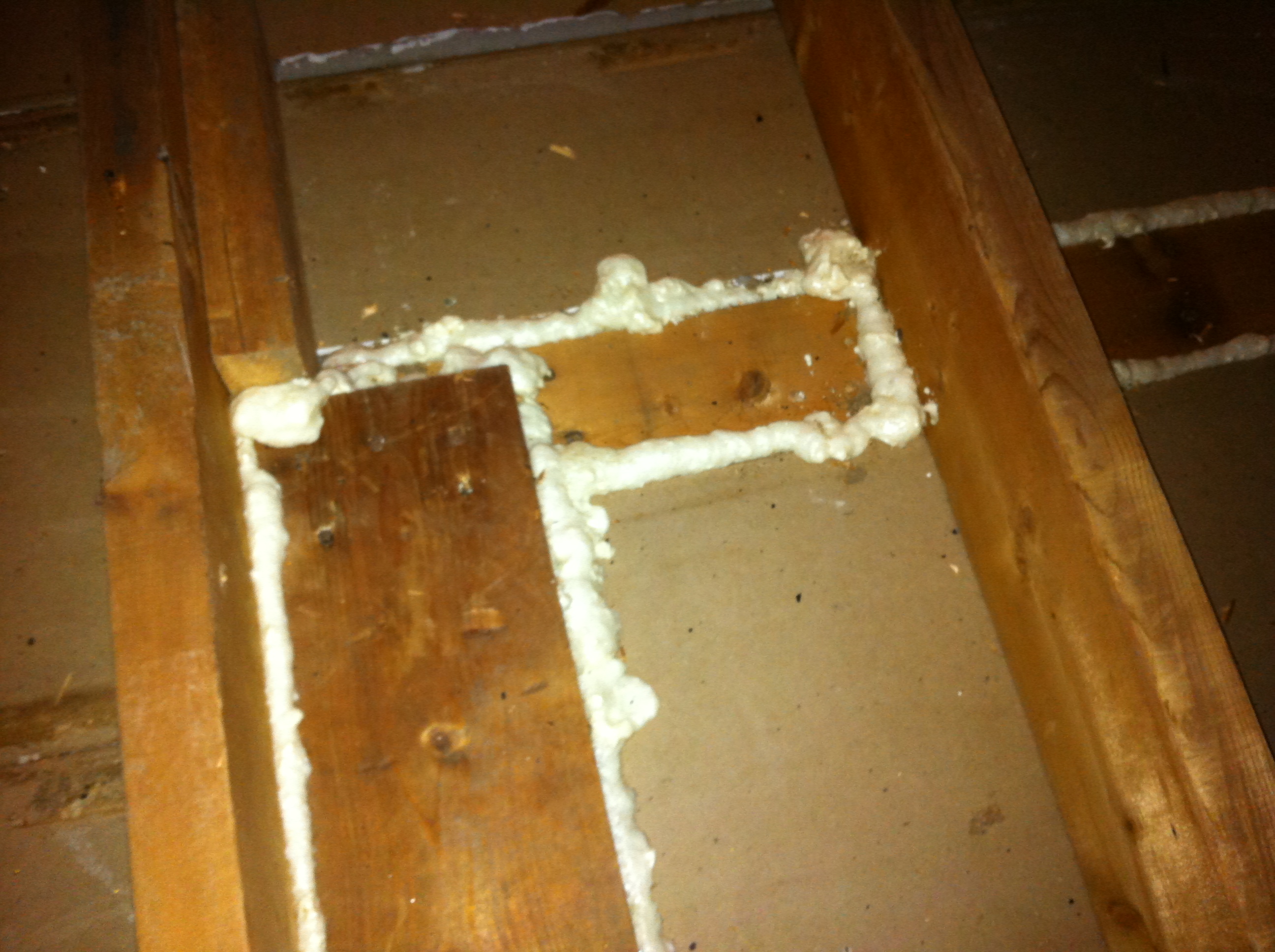
Sealed top plate

Seal everything as well as you can. This one-part spray foam reacts with moisture in the air and expands about 10 times in volume. This type of foam sealant is a mainstay of air sealing work, but I have doubts about its longevity.

Between the two, air sealing seems much easier to grasp than insulation.  Yet, when I talk to folks about making their houses weather-proof everyone knows they need insulation but few people accept they should seal up holes.  Let’s start with this proposition: you’re trying to stay comfy on a raw November day in North America.  The kids come in from apple picking: red cheeked, laughing, trailing the dog.  They kick off their boots, but they leave the door wide open.  What do you do?  You air seal the door.  You don’t want the door open.  An open door lets the chilly, outdoor air in and the warm, indoor air out.  Not only does that take some expensive air and scatter it to the backyard, it also makes you uncomfortable.  You close the door.

Now imagine that the air you’ve burned fuel to warm up is leaving the house through hundreds of teeny doors in the top of your house, and chilly, uncomfortable air is coming into the house through hundreds of teeny doors in the bottom of your house.  Close the doors and you will be more comfortable and burn less fuel doing it.

I think the reason folks are reluctant to air seal is that they think the unintentional holes are so small that air couldn’t possible move through there in any quantity they’d care about.  While that might be true if the holes never were under any pressure whatsoever, the nature of trying to control your indoor environment is that you create a pressure difference between the inside of the house and the outside.  When it’s warmer inside, the top of the house is under positive pressure (air is exiting through the teeny doors); when it’s warmer outside, the top of the house is under negative pressure (air is coming in through holes).  It’s physics.  You can’t stop it.  And some of the holes aren’t small, either.  As long as there are holes and the inside of the house is a different temperature from the outside, air will leak into and out of the house… continually.  And I haven’t even talked about wind.  Let me just sum it up this way: holes in your house leak air and make you uncomfortable.
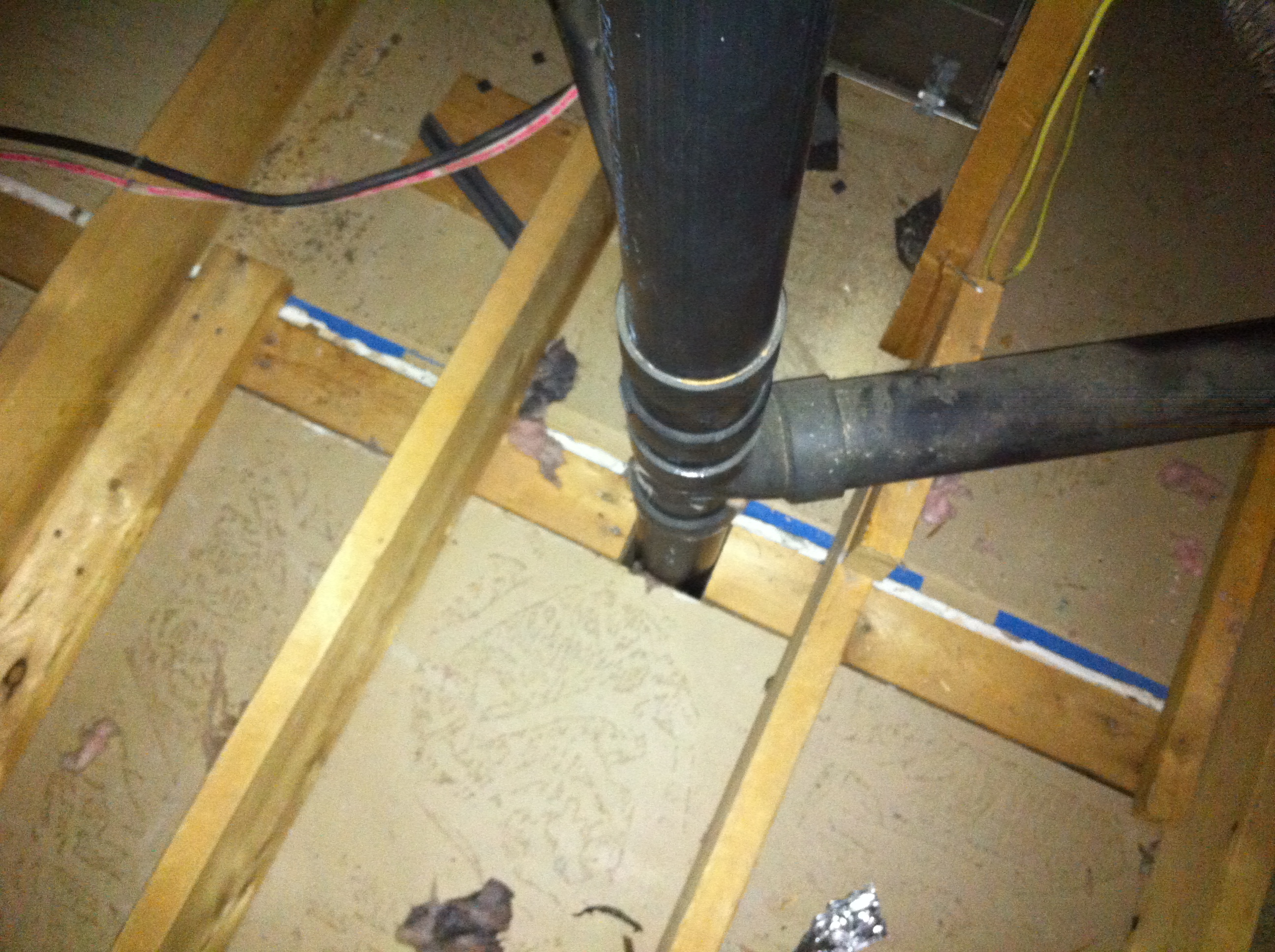
Penetration through a top plate

Some holes in the building aren’t small.

After having the vermiculite removed so I could work in the attic without being exposed to carcinogenic dust, and doing a blower door test so I’d know the baseline condition of the house, it’s time to air seal the attic.  I’m approaching this as though I want my ceiling as tight as the hull of a boat.  I’m going to seal absolutely everything and I’m going to do it in the most thorough way that I can.  My attic is a relatively pleasant place to work but I pretty quickly discover that some important areas are nearly inaccessible.  The low-pitch roof that is so nice for our solar system makes it impossible for me to seal up under the eaves.  I’m absolutely not willing to concede defeat in those areas so I talk Nicholas into exposing those areas through the soffit in the front of the house and through the original, concealed roof deck in the attic of the addition.

Tight access to perimeter wall

Under the lowest part of the roof the top of the wall is almost impossible to seal up.

When our solar installers obligingly remove the soffit for us, guess what?  Vermiculite, that’s what.  Turns out that spot was just as inaccessible to the vermiculite removal folks as it is to me.  So much for not exposing our workers to hazards.
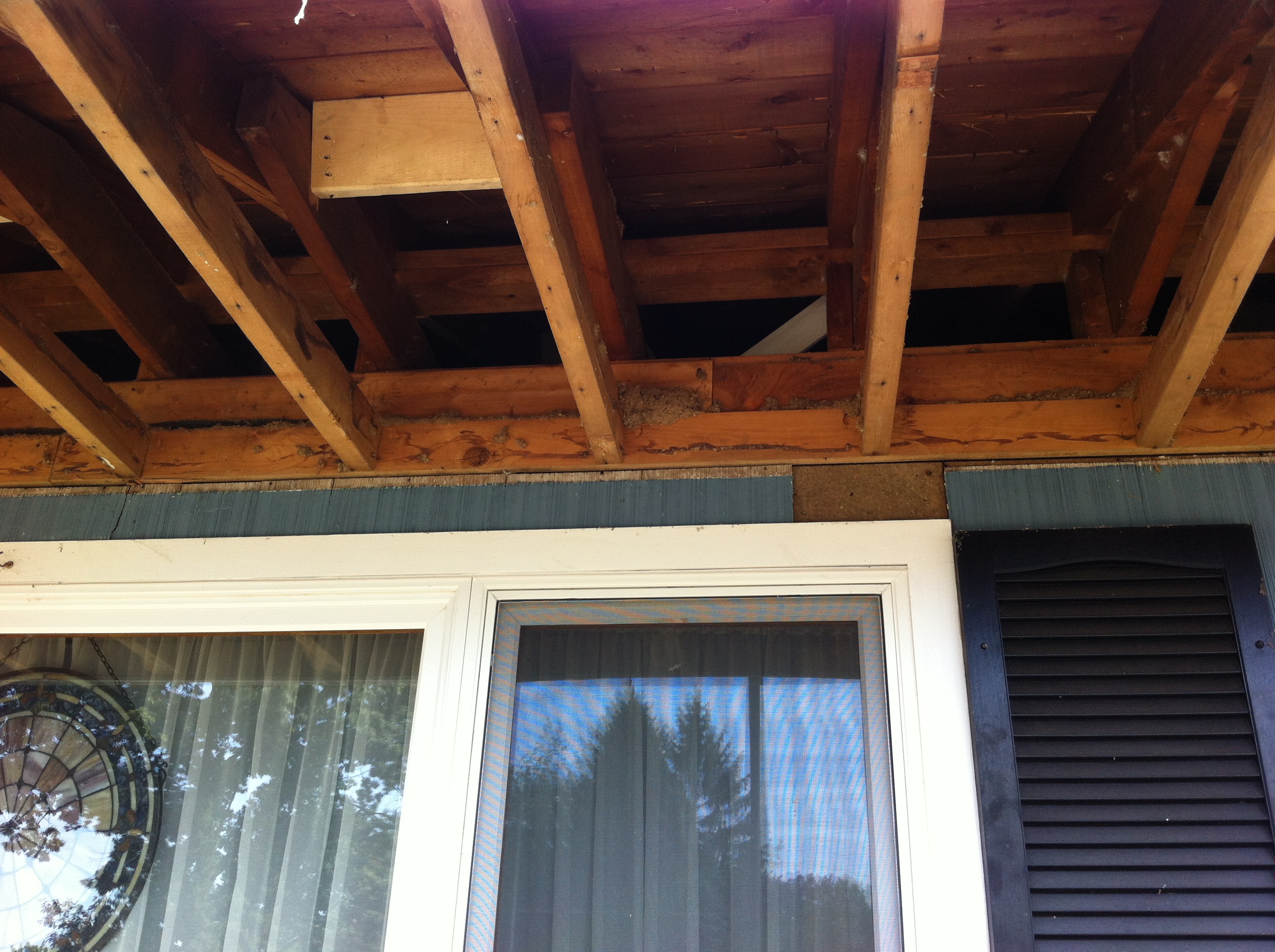
Under eave of roof

The top of the outside walls can be accessed from the outside once the soffit has been removed.

Up in the attic Nicholas takes a sawzall to the board sheathing on the old roof that got covered up by the addition, and removes about 8” of roof deck.  I see a big gap where the original house meets the addition.  Just what I expected, and definitely something I want to seal up.  Guess what else?  Vermiculite, that’s what.
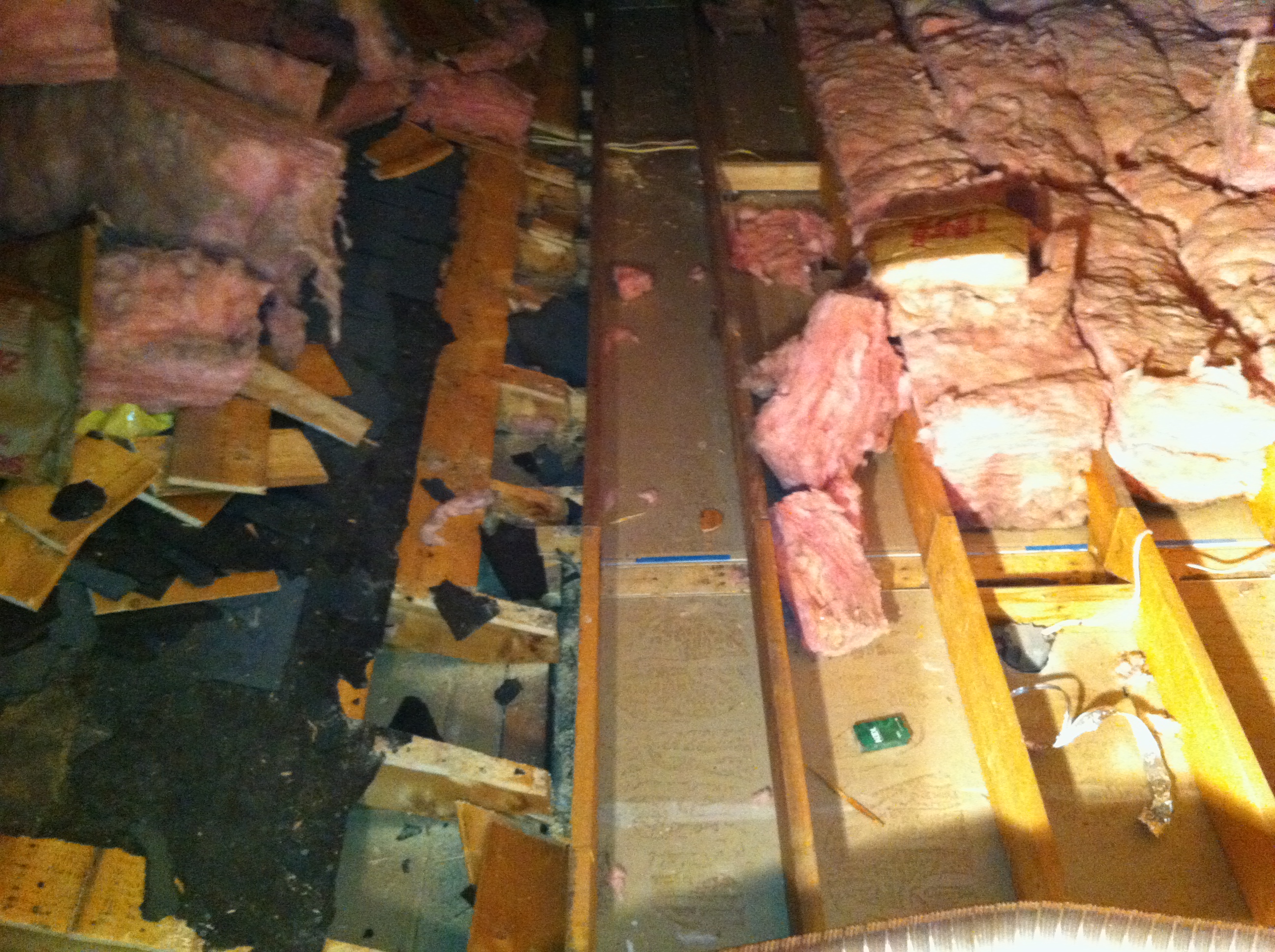
Old roof in attic of addition

The original roof was covered up when the addition was built. The junction between the old and new house needs to be sealed, but the original roof is in the way. You can see the gap between old and new in the debris-filled bay.

It doesn’t take long to find isolated spots of old insulation throughout the attic: some of it in plain-sight places that would have been very easy to clean up.  We avoid it, but I realize that in terms of how much vermiculite I’ve been exposed to, the remediation was a waste.  Nonetheless, without the remediation we wouldn’t be able to do any work in the attic, so seal on!
Posted by: Li Ling Young | September 9, 2012

The Blower Door Test

One of the foundations of efficiency work is, Test In, Test Out.  Meaning, know the condition going into a project, measure the condition after the work is done.  You want to know how much improvement was made; you want to be able to show that the goal is met; and you want to know that you’re not leaving a dicey situation behind.  There are dangerous but avoidable situations that arise when one ignores physics, but that’s for another post.

After we’d been living in the house for a couple of months it was time to do a blower door test in which I measure the air tightness of the building.  The blower door is a fundamental tool of building-energy-saving.  For this test you close up the house and use a big, calibrated fan to depressurize the house.  When you’ve reached the test pressure, you measure how much air the fan is moving, and that’s your test result.

Existing homes like ours (modestly-sized, simple shape) have blower door numbers between 1000 and 3000 cfm50 (the unit means cubic-feet-per-minute at 50 pascals of pressure).  New homes have blower door numbers between 200 and 1000 cfm50.  As a very rough guideline, homes that have been sealed up to the point where the blower door number is about the same as the square footage of the house are considered cost-effectively sealed.  In my opinion, that’s some pretty outdated thinking.  My goal for this house is less than 500 cfm50.  It’ll take a while to get there because there are parts of the house that won’t be accessible for air sealing until a later stage in the work, and that’s a pretty aggressive goal anyway.
I want to know what the original leakage of the house is before we do any work.  Not having done the blower door test was actually holding up our air sealing work.  One of the first things we did was add two recessed light fixtures to the living room (there wasn’t ANY lighting in the living room!)  So, I had to seal those up just to get the house back to the original leakage condition.  By the same token I couldn’t wait too long to do the blower door test because I’d pretty soon start making changes to the house that couldn’t be returned to the original condition even if I wanted to.

An important consideration is the presence of vermiculite in the home.  The best, safest thing to do in homes that are known to have vermiculite is not to depressurize them.  You don’t want to cause any of the vermiculite dust to become airborne and get sucked into the house where people will breathe it.  Since we had the vermiculite in the attic removed I felt ok about doing a blower door test, but I wanted to do it when no one else was home.  Finally, my opportunity arrived: no one home all day long.  It only takes about 10 minutes to do the test.  Our blower door number was around 2300 cfm50: pretty leaky.

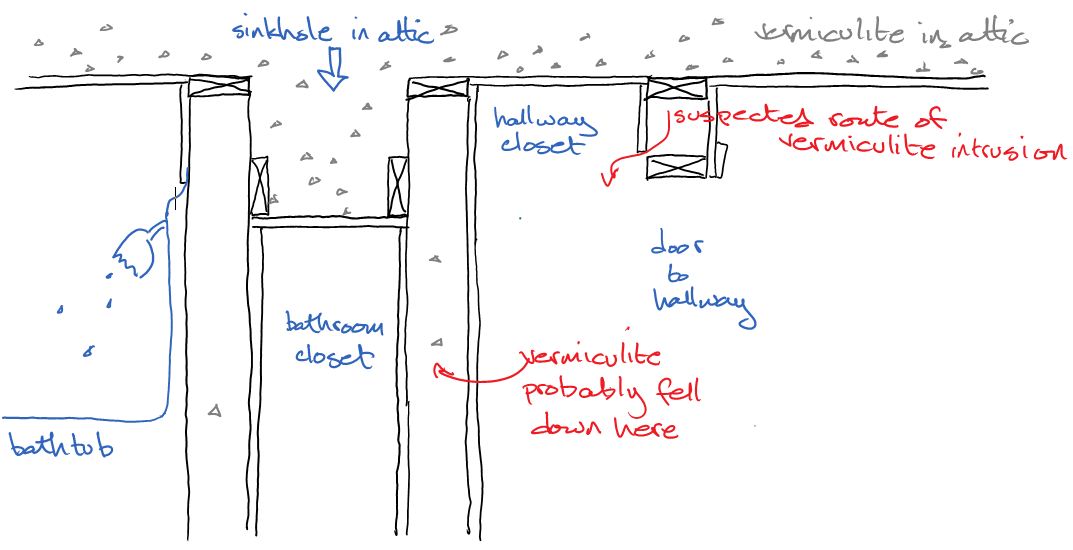
There are two known features of this house that contribute to high leakage.  A linen closet in the original bathroom has a dropped ceiling.  From the attic it looks like a sink hole in the attic floor, and the lower ceiling leaves three walls open to the attic in a way that they would not be if the ceiling were at the same height as the rest of the house.
The foundation of the addition is also leaky.  There is a leaky access door to the crawlspace, and the “shade” porch on the back of the house shares the same foundation, so air can move from the porch into the crawlspace and up through the floor of the 2nd bathroom.

Between the two of these things I would have expected the house to leak almost, if not quite as much as it does.  There are numerous smaller leaks too: the perimeter of the floor, which is uninsulated and unsealed; the wiring holes in all the top plates of the walls (visible from the attic), the fuel pipe into the garage, etc.  One thing you can do with the blower door is find the leaks.  I didn’t spend any time doing that because we’re going to seal everything up that we can reach, whether it’s a big leaker or not.  Over time, as our motivation, budget and time allow we’ll get to almost all of the thermal envelope of the building.  Knowing that it leaks (or doesn’t) in a particular location probably won’t change the order in which we get to insulating and air sealing that part of the building nor how well we air seal it.  Everything gets the same treatment: sealed as well as we can.

A couple of days after the blower door test I got into the linen closet in the hallway to discover potting soil all over the towels…  But no, it’s vermiculite!  I had sucked vermiculite into the closet and there was a lot of it.  I had broken the rule about depressurizing homes with vermiculite, and the worst had happened.  I just closed the door and told everyone not to use any new towels.  I was so demoralized I couldn’t even deal with it.  Eventually (weeks later, in fact) I pulled the towels out (very carefully) and carried them outside where I dumped the vermiculite into a garbage bag.  The towels got washed and dried in the usual way.  I took the shelves out of the closet and hosed them off in the backyard.  The floor and walls of the closet got wiped down.  I’m still not sure how the vermiculite got into the closet, but Nicholas discovered that the trim on the back of the closet door was missing, and that left a gap between the wall board and the door jam.  I sealed that up from inside the closet before I put everything back.  I’ve drawn the geometry of that part of the building as well as I understand it.

Any place where the ceiling is a different height than the rooms around it can be a bad air leaker and can allow stuff from the attic to fall down into the house.

Now I had a little conundrum.  I definitely did not want to depressurize the house again, so no test-out blower door test.  That means we wouldn’t be able to say how much of an improvement in air leakage we’d managed to accomplish.  There is another way, and it involved doing another blower door test, but this time PRESSURIZING the building instead of depressurizing.  It’s almost the same, but the overall numbers tend to be slightly higher.  I think it’s because the pressures in the fan are a little funny, but other building scientists have different explanations for the higher positive pressure test results.  No matter, because what I’m really interested in is the difference between the starting condition and the ending condition.  At test-out we’ll do another positive pressure test so we’ve got comparable numbers.  I still want to beat 500 cfm50 when all is said and done, and if I can do it with a positive pressure test, then hurrah for me.

I did the positive pressure test and the result was about 2400 cfm50.  Now that I’ve pegged the starting condition leakage of the house, we’re free to start air sealing everything we can get our hands on.  It’s about time!

Posted by: Li Ling Young | September 4, 2012

Vermiculite Contains Asbestos

When we bought our house we knew that it had vermiculite in the attic, and we knew that we wanted it out.  The seller was willing to share some of the cost of removing the vermiculite and gave us $5000 off the cost of the house price.  The vermiculite removal cost about $7500.

The main reason we removed the vermiculite is that we intended to do aggressive air sealing and insulating in the attic.  In a ranch the attic is a large part of the envelope of the building.  Fortunately, that means about 25% of the envelope can be easily accessed and upgraded without having to disturb the finished surfaces on the inside or outside of the house…  Unless there’s poisonous stuff all over the attic floor.  On our way toward energy Valhalla we need to be able to make an awesome thermal envelope at the ceiling.  The vermiculite had to go.

I like to think of vermiculite as rock popcorn.  It’s not a bad insulation, though it has a low insulating value per inch.  It can withstand very high temperatures, which makes it good for insulating around chimneys.  However, the source for 70% of the US’s vermiculite, the mine at Libby, Montana, also contains a vein of asbestos.  It’s prudent to assume that any vermiculite installed before 1990, when the Libby mine was shut down, contains asbestos.  In fact, testing for asbestos in vermiculite is an unreliable way to determine whether your vermiculite is contaminated.  Just assume any old vermiculite has asbestos in it and treat it accordingly.

So, what’s so bad about asbestos?  Inhaled asbestos can cause several kinds of lung cancer.  Asbestos fibers are very tiny.  Neither a dust mask, nor your nose hairs will catch them, and they lodge deep in lung tissue.  Many years after exposure to vermiculite those fibers can cause a tumor to grow.  I appreciate my lungs.  And I like to think I would never ask a worker to do something personally hazardous (even if they’re not so fond of their lungs as I am of mine).  No vermiculite if work is going to go forward in the attic.

We hired Alderson Environmental to remove the attic insulation.  They are licensed by the state to remove and dispose of asbestos.  I asked them what their process would be, how they make sure vermiculite dust doesn’t get into the house and how they dispose of the vermiculite. They do a lot of this work because a lot of homes in this area have vermiculite in them.  As part of the contract Alderson disclaims not all of the vermiculite will be removed.  Some vermiculite may remain, for instance in electrical fixtures.

We were lucky that Alderson could schedule us for immediately after the closing, so that by the time we moved in the vermiculite removal would be done.  I stopped in while they were doing the work.

The environmental company built this containment area in our garage. The workers enter the work area through this containment area and are decontaminated here..

The workers shower after having been in the work area. These showers are in the containment area so they don’t track hazardous material outside the work area.

Here’s their containment zone with showers for the workers.  Pretty impressive.  Air quality testing inside the house is done continuously during the work.  After the work was done someone from a state lab came and did air quality testing in the attic.  The jobsite failed air quality testing so they had to leave a giant fan in the attic over the weekend and retest on Monday, when the test showed everything OK.

« Newer Posts - Older Posts »

Categories