Posted by: Li Ling Young | September 4, 2012

Choosing Basement Insulation

For those of you not obsessed by the medieval fantasy novels and television show, Game of Thrones, it’s a dangerous world for those with power and those without: a sexually violent and unjust world for the cunning and the guileless alike; doom crowds in on all sides, and even if your enemies defeat each other before getting to you, there’s always Winter.  Now we can all appreciate the irony of the young, soft father pushing the tricked out stroller with the cup holder (for the pusher!) through our neighborhood to the bakery on a Sunday morning wearing a Game of Thrones shirt: Winter Is Coming… in black, of course.

Yet even in this suburban world of lawn mowing, baseball games, neighborhood bakeries and scooters left on the sidewalk, winter is actually coming.  It’s time to get serious about insulating this house.  The question today is, how do we insulate the foundation?  We’ve got two areas we can get to without disturbing any of the finish surfaces: the basement walls in the utility room (about half of the basement), and the crawlspace walls under the addition (pretty sizeable addition).  The walls are concrete block in the basement and poured concrete under the addition, so they are flat enough that foam board is the best choice.

Foam board is nice because it can be applied directly to the wall without any framing to hold it up; it’s easy to seal up; it’s got a high insulating value.  Downsides: expensive and slows drying.  And then there’s this one: as a plastic, foam board is made with some pretty nasty stuff.  One of them is the blowing agent that causes the bubbles to form so the plastic doesn’t conduct energy.  Some of the blowing agents are potent greenhouse gases.  If you want to do what you can to slow climate change, saving energy by using a greenhouse gas-intensive product is a bad proposition.

Following a hotly debated article by Alex Wilson of Building Green, energy efficiency consultant David Whitecreated a handy tool for comparing the global warming potential of insulations.  Here’s a little snip of the tool.
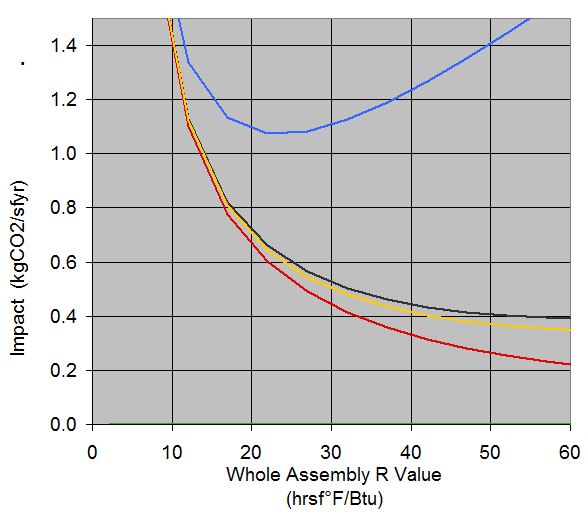
Greenhouse gases associated with insulation

As you add more insulation the amount of energy saved by each subsequent inch diminishes while the blowing agents stay the same.

Along the bottom it shows the level of insulation.  As you add more insulation, each additional bit saves less energy than the previous bit because there’s just less to save.  Therefore, the curves flatten out at the higher end of the scale because your benefit is falling off.

Along the left it shows greenhouse gas emissions: combined blowing agents released from the insulation plus emissions from burning fossil fuels and losing heat through the envelope of your house.  The curves start high on the y axis because the energy lost through low insulation means high greenhouse gas emissions.  Add a little insulation and the amount of greenhouse gas emissions drops rapidly because some insulation in a poorly insulated home makes a big difference.  Add more insulation and you save more energy, but you also have more blowing agents, so the line stops dropping quite so fast.  With some insulations you actually get to a point where more insulation contributes more greenhouse gases from blowing agents than it saves in fuel, so there’s a line that turns up and starts going the wrong way.

The one that’s going the wrong way, that’s the most common foam board insulation used in homes.  That insulation would make this house an energy freakshow, but in the wrong way: the hypocritical and incoherent way.  So, if we’re not going to use extruded polystyrene, the easy-to-buy default insulation, what do we use and where the heck do we get it?

The chart shows three other insulations.  One is there as a reference and isn’t a contender:  cellulose (red line), which is my favorite insulation, made entirely from mashed up newspaper and cardboard.  I thought it would be a good baseline because it is made from recycled materials.  Cellulose isn’t a foam board.  The curve in between extruded polystyrene and cellulose is two insulations that have almost the same greenhouse gas profile: expanded polystyrene and polyisocyanurate.  To keep them differentiated I use EPS for expanded polystyrene (good guy), XPS for extruded polystyrene (bad guy) and PIC for polyisocyanurate (other good guy).  Both EPS and PIC are good candidates for insulating our basement.

There are a few other things to consider.  There are small differences in the insulating value of the foams.  Two additional important considerations are moisture transport and fire.  Walls that have dirt on the other side are always a little bit wet.  In my opinion it’s nice to have a way for that moisture to evaporate away.  Unfortunately since the foam boards are plastic, they don’t allow for much vapor diffusion.  EPS is a little better on this score than XPS, and PIC is absolutely the worst because almost all the PIC products have some sort of foil facing which allows no drying whatsoever.

For fire safety foams are required by code to be covered by a thermal barrier.  During a fire this prevents the foam from emitting disabling gases for a few minutes so the occupants can get out of the building before frying their lungs.  The PIC comes in a version with thermal barrier attached.  Neither EPS nor XPS are manufactured with a thermal barrier, but drywall can be added over the foam to provide a thermal barrier.

Taking all that into consideration: greenhouse gas emissions, insulating value, drying potential, fire safety and cost, I decided on EPS foam with no thermal barrier.  Perhaps we’ll add drywall sometime later.

Now, how much foam?  One of the advantages of EPS is that it is manufactured in many different thicknesses.  Here’s a product made with 10” of EPS.
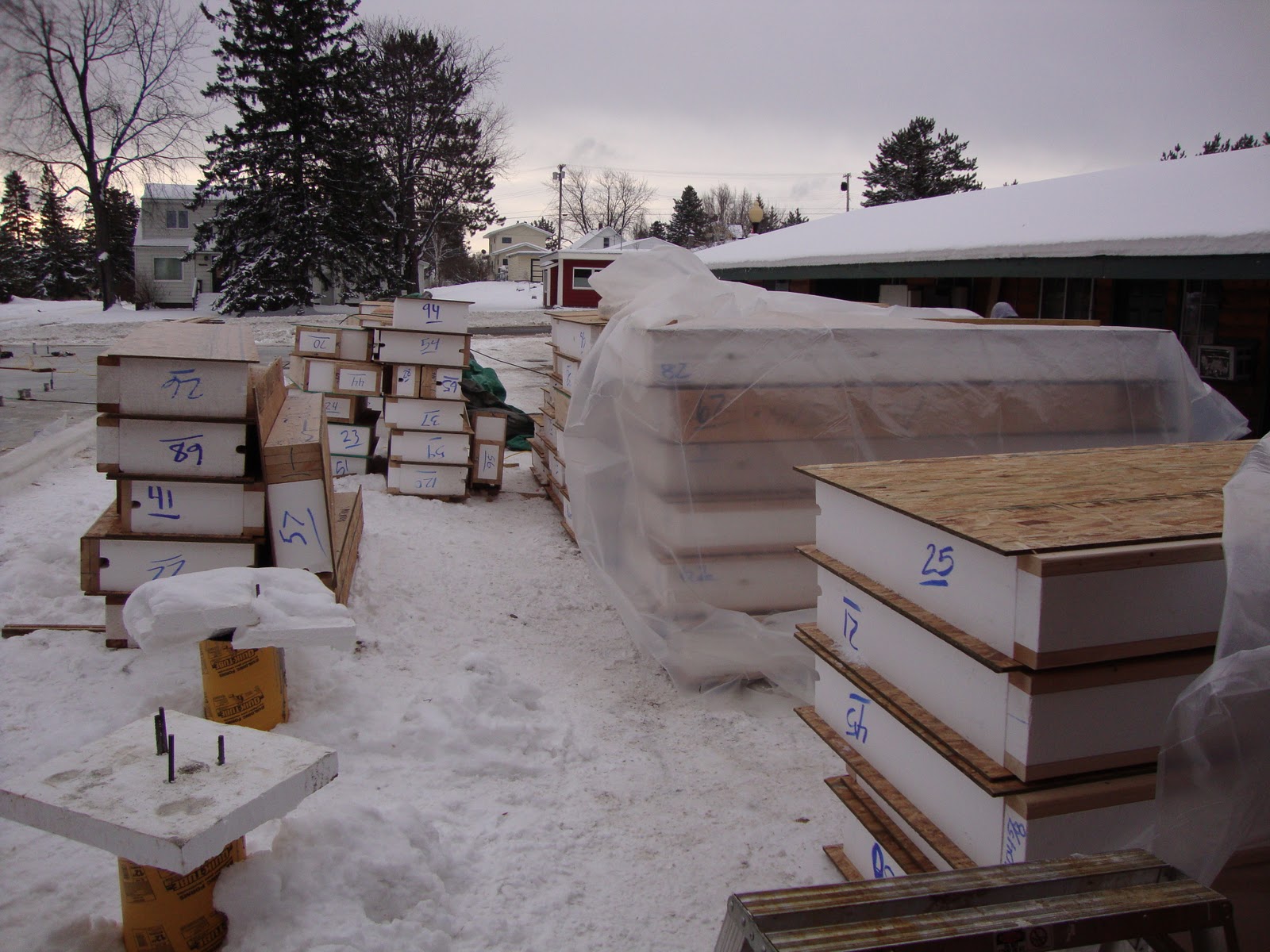
Structural Insulated Panels with 10" EPS core

EPS is manufactured in many different thicknesses.

Given the insulating value of EPS, about R-4 per inch, and that we will have the option of adding more layers of foam in the future I decided on a minimum of 4” of foam for our first effort.  If I were building new or had a more roomy budget I’d want to double that.  I feel pretty good about 4” given that we’re starting with completely uninsulated basement walls.  When I’ve recovered emotionally and financially from this first flush of energy improvements, I’ll tackle the question of how to insulate the walls of the finished basement.  Only then will it make sense to go back and add more insulation over the 4” of EPS.

Costing…  To start with, EPS is a bit of an oddball product.  It’s used in a lot of packaging (the molded foam blocks that cushion the toaster in the box).  But it’s not as common to find it used in buildings.  When I call around looking for EPS at the supply houses I’m going to have to be extra careful that they don’t think I want XPS, otherwise my whole exercise with the greenhouse gases will be lost.  Our local building supply, Curtis Lumber, wants to know how many sheets I’m buying.  In all likelihood I’ll have to buy this stuff by the palette, so no small orders.  After a week they still haven’t gotten back to me.  Nicholas suggests Sticks n’ Stuff, which is pretty far away, but will deliver for cheap.  Again, it’s a special order, so palette-fuls only.  They get back to us with a price for 4” XPS.  After some clarification they call us back with a price for 4” EPS, $42/sheet (4’X8’).  That’s less than half what the XPS cost.  We need 21 sheets for the basement and crawlspace: about $950 all told.
Posted by: Li Ling Young | August 28, 2012

The Humble Lightbulb

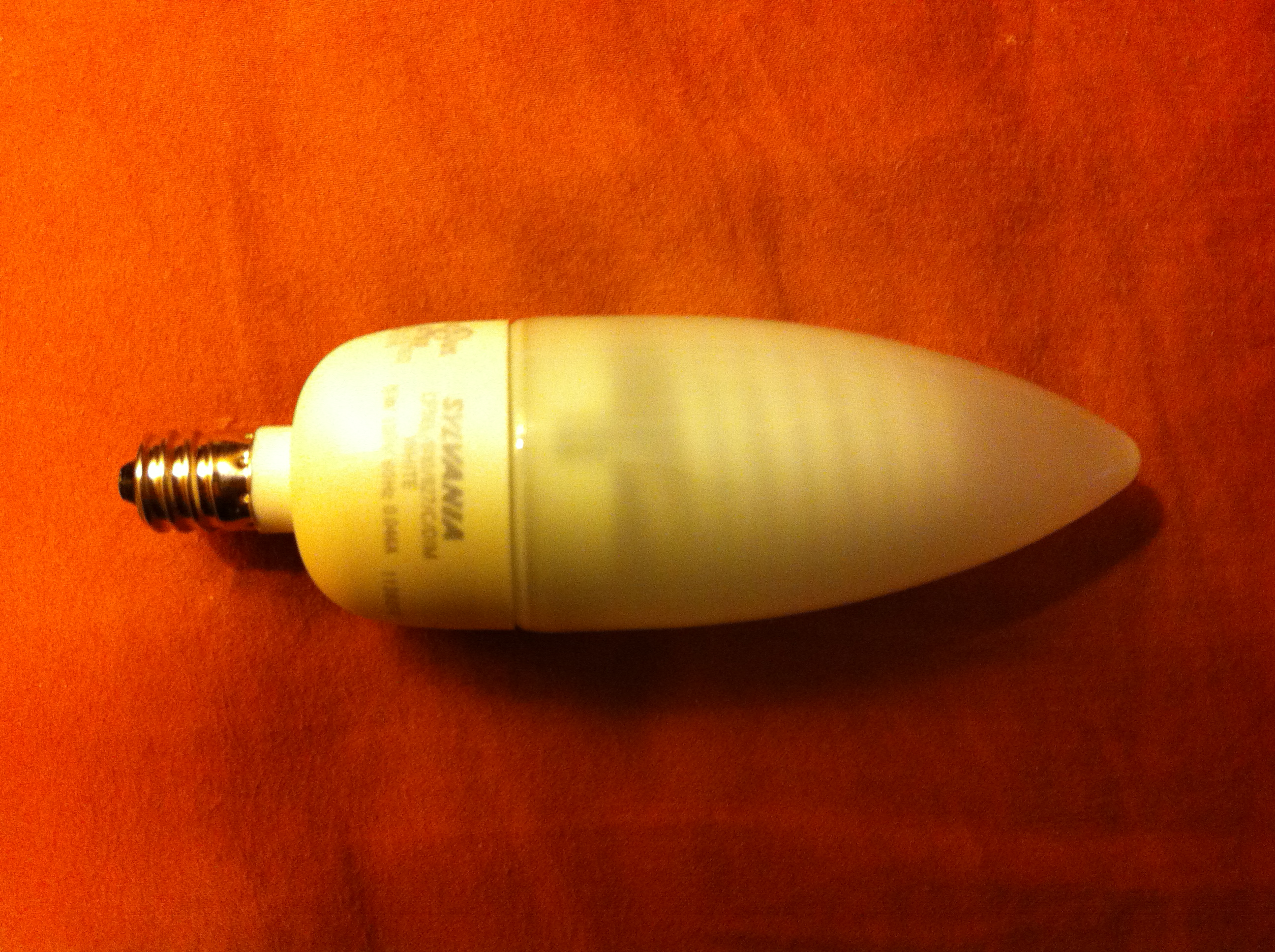
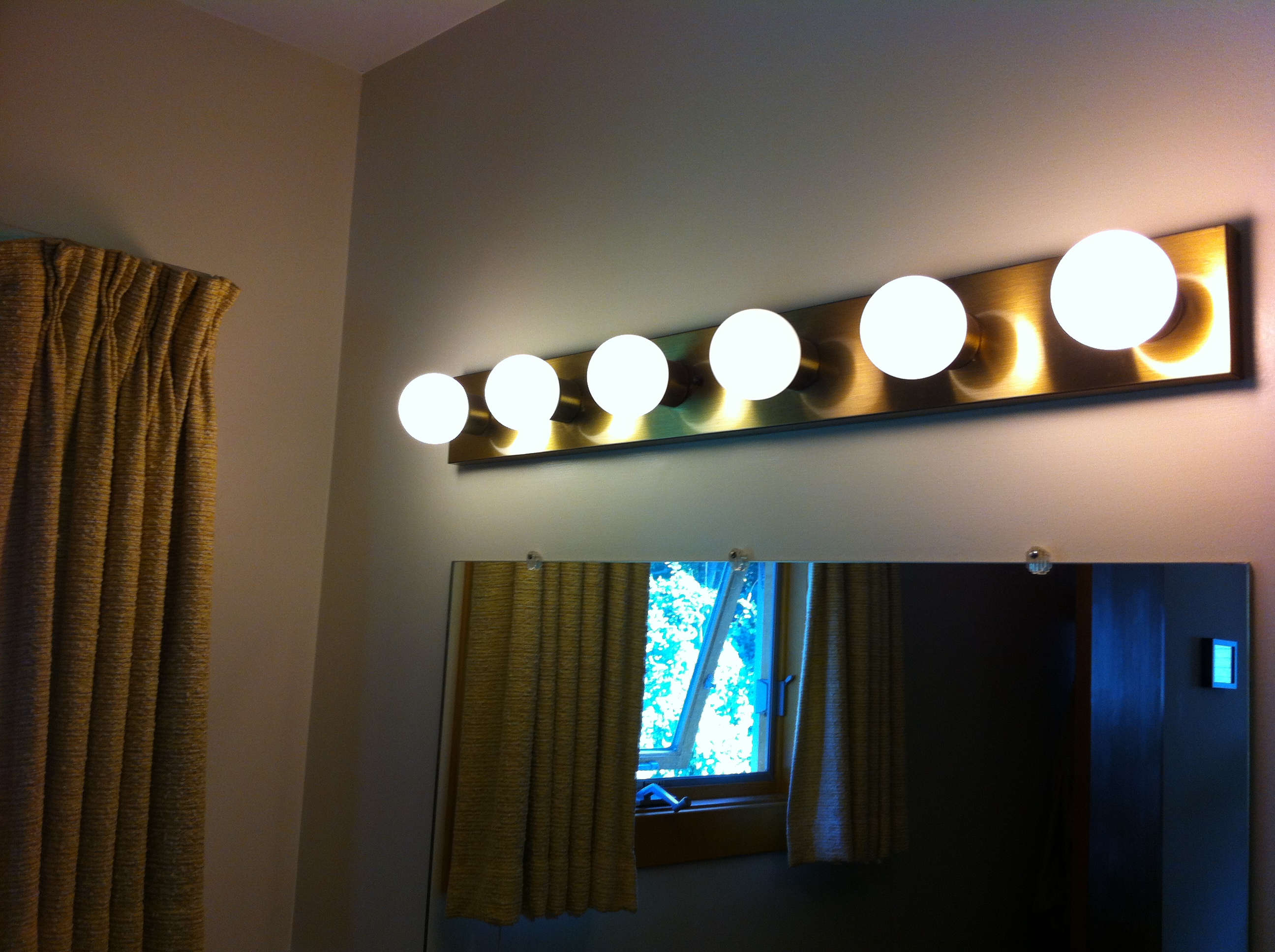
Globe compact fluorescent light bulbs

These globe compact fluorescent light bulbs use 9 watts each.

When we moved in to our new house there was not a single efficient light bulb in the whole place.  That’s pretty unusual  Efficient light bulbs have been on the scene for almost 20 years.  I remember getting a coupon from our electric utility for a cheap compact fluorescent about 14 years ago.  Nicholas went right out and used that coupon.  I was still in my infancy as an energy geek and didn’t much care about it.  Since then our state has had an aggressive campaign to get compact fluorescent light bulbs into homes.  Prices are subsidized to help folks buy compact fluorescents and retailers like hardware stores and supermarkets are coerced (in the nicest way) to give them shelf space and to stock specialty bulbs like these globes in our bathroom. So, a house with NO efficient light bulbs?  How?  Who?  Why?  We’ll never know.  But clearly we wanted to swap those light bulbs out right away.

Right away?  Really?  Top priority?  Well, yeah.  Lighting may seem kind of uninteresting compared to…  the water heater?  Insulation?  OK, none of this stuff is inherently more interesting than any of the rest of it.  But here’s what makes light bulbs top of the list for any energy saving effort: they’re cheap to buy, expensive to operate.  An incandescent light bulb, the bulb that Thomas Edison refined, is best described as a tiny, fragile heater that you only use at night.  In the past lighting was one of the biggest electrical uses in a home (typically second only to the refrigerator).  Because incandescent light bulbs make so much heat, they use a lot of electricity.  And in the summer, they make your house hot.  However, if you choose an efficient light bulb the electricity you save can pay the cost of the new light bulb back in as short as a year, yet they last 5 years and up.

So we started buying new light bulbs the week we moved into the house.  Honestly, it seemed quaint those incandescent bulbs: kind of like kerosene lamps.  But every one of those bulby-shaped bulbs was an opportunity to time warp from the 19th century to the 21st century.  And now the hard part…  Which lighting technology to throw our lot in with?  I’ve been screwing compact fluorescent bulbs into other people’s lamps for so many years I’ve become institutionalized about fluorescents.  I can tell you how many micrograms of mercury in a compact fluorescent.  I know how many lumens you want for replacing a 100 watt incandescent.  I can talk color rendering index and color temperature.  And I know there is no such thing as a full spectrum compact fluorescent, but also there’s no such thing as a full spectrum incandescent bulb.  I’ve been a fluorescent booster.  I’ve also spent much of that time cooling people’s excitement over LED’s.  I’m still at a loss to explain how LED’s so successfully caught the popular imagination.  Catch it they did, and long before LED’s were good enough for residential general lighting.  Three years ago LED’s had color problems, poor temperature control, low efficacy (the lighting term for efficiency), short life, high cost…  I told people, it’ll be five years before LED lighting is ready.  A year ago DOE announced the L Prize: a replacement bulb for the 60 watt incandescent with an efficacy of 123 lumens per watt and a raft of light quality and longevity credentials.  I wish I could say I’ve never been so wrong.  Actually I’m exactly that wrong quite frequently.

Cold cathode compact fluorescents are dimmable and don't wear out if you "blink" them.

This cold cathode compact fluorescent could last for 50 years. They’re used for marquis because they can blink and not wear out. Here it was just the brightest efficient bulb that fits.

In the end we used both compact fluorescent light bulbs and LED light bulbs to replace all those dinosaurs.  As much as I wanted to make my home a showcase for fluorescent lighting, every compact fluorescent I bought seemed like an already obsolete technology: like my dad getting into the pay phone business in 1999.  For the first time I saw an L Prize bulb in a store, for $20.  The price may seem ridiculously high, but that’s actually an amazing bargain.  I bought one.  A week later Nicholas found the L Prize precursor on clearance for $5 per (Philips made a near-L Prize bulb while they were developing the really good one for retail marketing).  We bought a couple cases.  The fluorescents are the globes in our bathroom, the reflector bulbs in the outdoor spotlight and some super specialty bulbs in our ceiling fan: cold cathode, candelabra base.

By all rights we shouldn’t have to replace a light bulb for at least 5 years.  The L Prize bulb went into the only dimmable fixture in our house: over the dining table.  It should last 20 years.  Now there isn’t a single non-efficient bulb in the whole house.  We’ve cut our lighting wattage about 80%.  The light bulbs can go back to being humble and inconspicuous.  Now they’re just foot soldiers on our march toward energy balance.

Posted by: Li Ling Young | August 28, 2012

Getting that big, fat pig-of-a-water heater to fire

For one week our solar system is operational but we’re not selling electricity to our utility.  Until we have our electrical inspection and the utility replaces our meter with a reversible meter any electricity we generate is a freebie for the utility.  As a result, we can only benefit from our PV system if we are using electricity at the same time it’s being generated.  This leads to a sometimes comical situation in which our energy-consuming activities are delayed until we can do them for free.  I think of it kind of like eating local, but on a daily cycle instead of a yearly one.

Remember, this is only for the one week.  After that the utility credits us for all the electricity we generate, and we draw off that credit whenever we use electricity, even if it’s at night.  In case you’re wondering, we do actually use our own electricity when we are generating even after the whole keeping track and credit thing goes into effect.  It’s actually better for everyone that way because there aren’t any transmission losses, so the “efficiency” is a little better than it would be if the electricity were coming from Connecticut, say.  Also, my neighbors can use the electricity without the transmission losses, so really all our electrons are getting used up here on our block even when we’re selling our electricity back to the utility.  But all to the good.

So, today is the first day I feel intellectually equipped to try this seasonal solar eating.  Yesterday I forgot and turned on the dehumidifier and ran the wash 1) with the inverter off, and 2) at night.  Today I saved the breakfast dishes and the clothes drying until the sun could help with everything.  But it’s cloudy!  So, waiting, waiting.  Finally, the sun comes out and the inverter shows over 3000 watts.  OK, on goes the dishwasher, the dehumidifier, the refrigerator is already running, the wet clothes go in the dryer, I’m washing the pots and pans by hand.  Oops, we overshoot.  I’m not really sure why this is, but our whole-house watt meter is over 6,000 watts.  Anyway, I carry on using electricity like… well, there really isn’t a good metaphor for this that’s not totally cheesy, but you get the point; make hay and wash dishes while the sun shines.

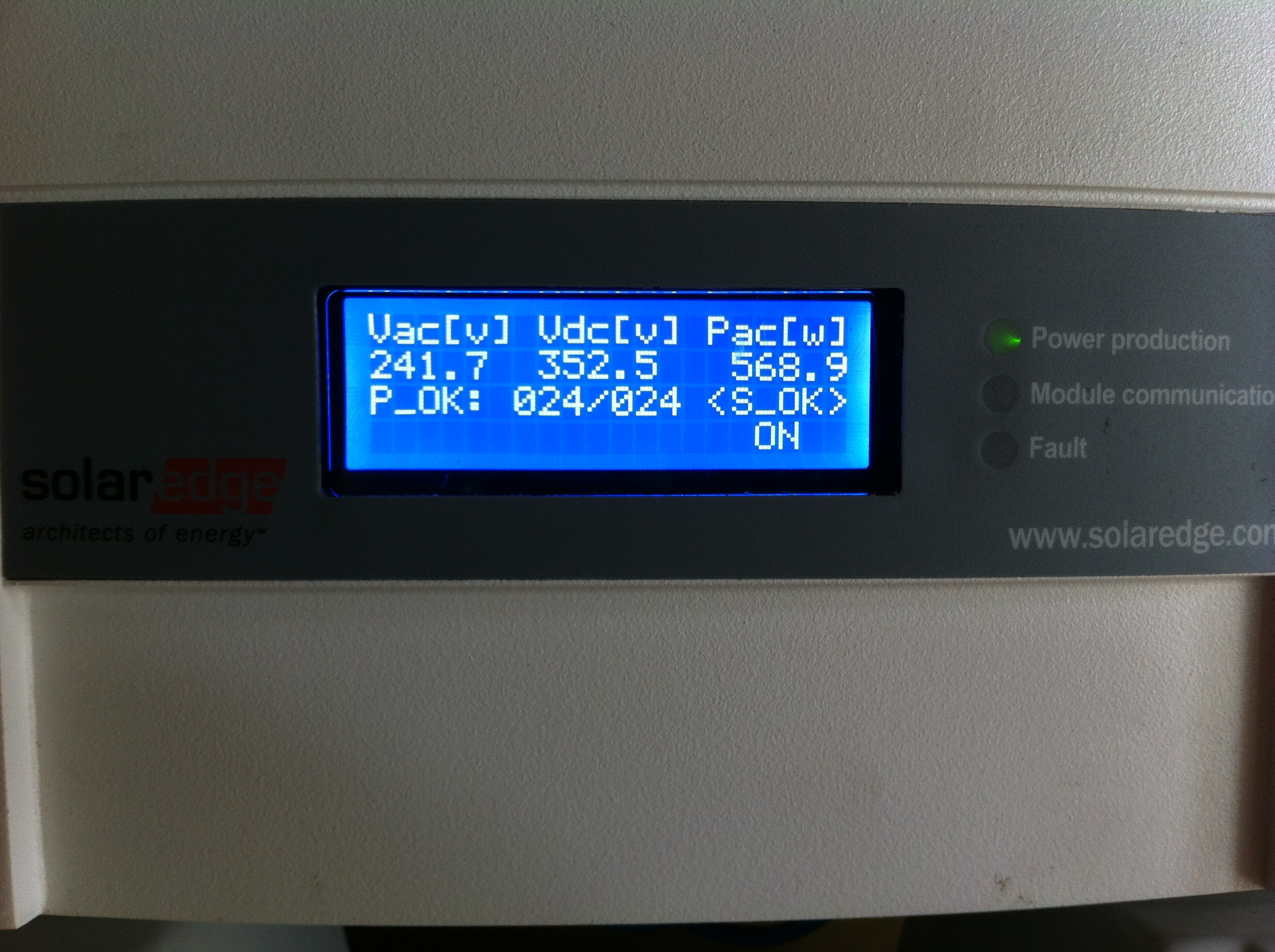
Using about a kilowattInverter display shows about half-a kilowatt electricity generation.

After I’m done with dishes I go check the water heater.  Because we have an 80 gallon water heater it doesn’t come on every time we use hot water.  It actually takes quite a bit of hot water use to drop the tank temperature enough to make the water heater come on.  But NOW is the time to make hot water, so I need to do something to get that water heater to fire.  I take a shower.  Now, generally a shower will get any water heater to fire, but we have very low flow shower heads and after a pretty long shower in which I actually wash my hair (also pretty long) I still haven’t used enough hot water to get the durn thing to fire.  Meanwhile, the sun keeps going behind clouds and the household electric use and the solar-generated electricity are matching a bit better.  I try one more thing.  Having already washed the laundry last night I have to look around for something that needs hot water.  The cute but well-abused rag rug in front of the sink and next to the garage door is feeling pretty sticky, so I throw that in the wash (all by itself!) and wash it in warm.  10 mintues later…  Still no water heater action!  At this point Nicholas comes home and I relate the whole thing to him.  He says…

Turn up the tank temperature.  Yes!  Of course.  Make hay.  Do we need the tank hotter?  No, but it’s a handy place to store energy.  And when it comes time to use hot water we’ll just use it more slowly because its a little hotter.  As soon as Nicholas touches the temperature dial the water heater fires.  It’ll go for a while because the tank is so big and you have to add quite a bit of energy to that much water to raise it back above the temperature setting.  Meanwhile, the sun is behind a cloud again.  Oh well.  Tonight I’ll turn the tank temp back down because we don’t really need the water kept that hot.

« Newer Posts - Older Posts »

Categories