Posted by: Li Ling Young | December 31, 2013

Icepocalypse, 2013

The weekend before Christmas it started raining on a Friday.  It didn’t stop until late Monday and the temperature stayed in the 20’s F the whole time.  The beautiful snow we’d gotten earlier in December first got a crust on top, then turned to 6″ of ice, then a thick coat of clear, slick ice covered the whole thing.  Then Jack Frost came to stay for the holidays, and after a few days in the single digits that snow-ice-concrete sandwich was tenaciously and treacherously stuck on everything.  Stuck.  Everything.  Then another round of freezing rain.

Freezing rain fell for 4 days.  Some lost power; there were road accidents; others got to enjoy the beauty.

Freezing rain fell for 4 days. Some lost power; there were road accidents; others got to enjoy the beauty.

Some of it was neat.  Trees glittered beautifully with a glaze of ice.  The car yielded up curved slabs of crystal exoskeleton.  A little breeze let loose tinkling shards of glass-like ice from the long-needle pine tree behind the house.

But there is a lot about Icepocalypse, 2013 that wasn’t cool at all.  All the folks who lost power, and STILL haven’t had the power restored, don’t think this epic ice storm is neat at all.  And everyone who has fallen on the ice, or slid off the road, or had to cancel travel plans is probably well done with this cute little storm.  We’re right in the heart of the area hit hardest with ice, but we’ve been lucky to escape unscathed.

The solar panels got covered with the whole snow-ice-concrete sandwich.  By the time the precipitation stopped there was no way to budge any bit of the ice.  We couldn’t even put a ladder against the roof with all the ice in the front yard.  There were a few, brilliant sunny days in there, when the temperature was around 2 deg F.  But the sun couldn’t penetrate the snow-ice-concrete.  Nik started getting calls from customers asking what could be done about their ice-bound solar panels.  At one point, when the temperature warmed up into the 20’s, Nik tried spraying hot water onto the panels.  That made the driveway pretty interesting, but did nothing to shrink the roof ice.  It was about this time that I saw a lady swinging an axe at her front steps.  Not a frontier farm wife: a suburban lady with an axe!  I’m sure many people have considered antifreeze, rock salt, electric heat tape and various sharp instruments for removing ice from roofs.  But when it comes to solar panels, this advice I overheard Nik giving to one of his customers is probably right on:

  • With the sun so low in the sky, the amount of energy you’re missing out on is pretty small
  • You’ll use up more energy trying to melt snow (with electric heat tape, hot water or hot air) than you’ll gain by clearing the panels
  • Just have some patience, the next warm day will give you a much better shot at clearing the panels without endangering yourself or your solar system
Nik and the only thing that will budge the ice: a 2X4.  The lower panels had been cleared a few days before, using a windshield scraper.

Nik and the only thing that will budge the ice: a 2X4. The lower panels had been cleared a few days before, using a windshield scraper.

Eventually we had a 40 deg F day and Nik fought his way onto the roof with the only thing that could safely knock loose some of the ice.  He managed to get about 80% of the snow-ice-concrete off, but underneath it all was a firmly stuck-on layer of frozen rain.  The next day was much colder, but sunny, and the sun-warmed panels warmed up enough to melt most of the remaining snow-ice-concrete, very slowly.  At the end of the day only about 10% of the panels was still covered.  We made 21 kWh of electricity.  Following on our lesson with the leaf, that 10% probably really hurt the energy output, but now with most of the panels exposed the sun will eventually do its job and melt the rest away.
Posted by: Li Ling Young | December 23, 2013

Mini Split: Solar’s Best Friend

Last summer we finally installed our mini-split heat pump.  This is our second heat pump, following on the heat pump water heater we installed a year ago.  See the post about heat pumps to find out why.

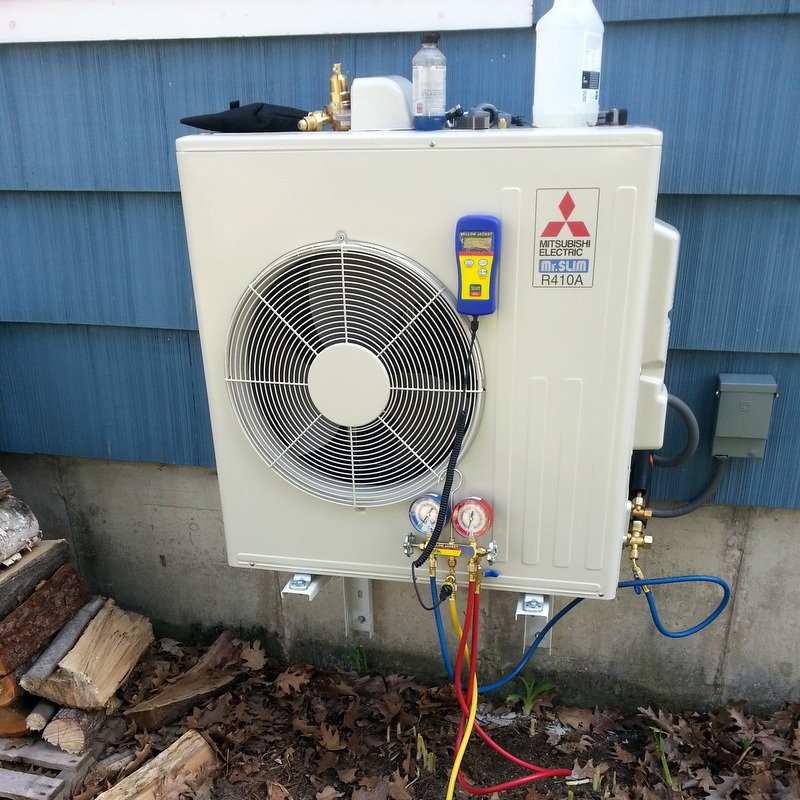
The mini-split heats (and occasionally cools) the house.  This 3′ X 3′ compressor is mounted on the outside of the house.

Outdoor Unit (during start-up)

Outdoor Unit (during start-up)

And this 4′ wide blower is mounted in our dining room.

The heat pump delivers heat to a central place in the house.

The heat pump delivers heat to a central place in the house.

We chose a mini-split because it uses electricity to make heat, and electricity is plentiful and free at our house thanks to our photovoltaic solar system.  The heat pump enables us to use electricity at greater than 200% efficiency: possible because the heat energy comes from outdoor air.  Electricity is used just to get the energy from outside to inside, and to “concentrate” the energy for a higher temperature.

Our mini-split is a Mitsubishi Hyperheat, one of a new generation of mini-split heat pumps that are designed for cold climates.  The Hyperheat can deliver heat when it’s as low as -13 degrees F outside.

With a renewable energy system like PV and a heat pump heating system a home could become “net zero energy”: generating as much energy as is used over the course of a year.  As appealing as that may sound, there are lots of things to consider before selecting a mini-split heating system.

  • Currently cold climate heat pumps only come in this “ductless” model, which means heating and cooling can only be delivered to one spot in the house.  If the house layout isn’t open enough a single mini split will not keep the house comfortable.  Our house is blessedly small, but as was the fashion in the 50’s, not at all open.  The room with the mini-split gets very warm, the bedrooms are often too cool.
  • The mini-splits don’t make a lot of heat, and as the outdoor temperature drops the output of the mini-split drops too.  Most homes will need more heat than a mini-split delivers, particularly in very cold weather.  We have a woodstove to supplement the mini-split.
  • Even though the mini-splits are highly “efficient” they still use a lot of electricity.  With expensive electricity rates or with demand charges on your electric account a mini-split could be very expensive to operate.  If you make your own electricity, as we do, heating with your heat pump is free, but it’ll eat up a lot of your home grown energy.

We won’t know until a year has gone by whether we harvest enough solar energy to run the whole house including the mini split.  In the meantime it just feels neat to float along with no energy bills month in, month out.

Posted by: Li Ling Young | December 22, 2013

Payback, baby!

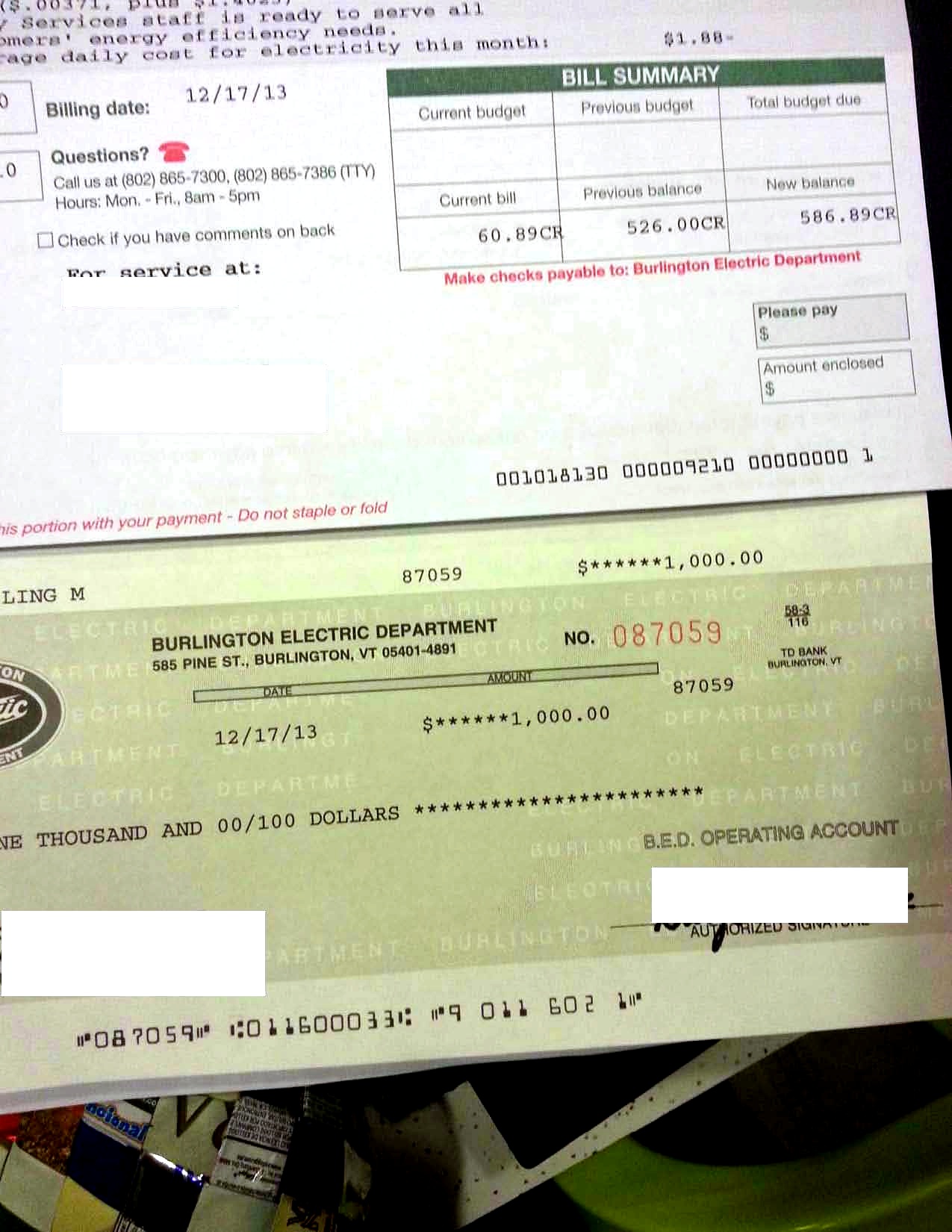
Our utility sent us a $1000 check for the electricity we generated with our solar panels.  We still have a $586 credit to carry us through the rest of the cloudy season.

Our utility sent us a $1000 check for the electricity we generated with our solar panels. We still have a $586 credit to carry us through the rest of the cloudy season.

It’s been 16 months since we fired up the PV array (solar electric system).  We’ve been making more electricity than we use ever since.  Thanks to Vermont’s energy-friendly regulations we hold on to that electricity credit for the lean months, and our utility even credits us a “solar adder” which amounts to almost 30% extra.

Last year we heated with wood, but this year things are different.  Our primary heat is now a heat pump, and we now charge our electric car at the house.  We’ve been dipping into that solar electricity surplus in a big way.

As I talked about in the Seasonal Energy post, Vermont only requires utilities to hold onto a renewable energy surplus for 12 months.  When it became clear that we weren’t going to use up last year’s 10,000+ kWh of solar electricity I called our utility to find out how quickly it would be disappearing off our balance.  Much to my delight, I was told our utility doesn’t expire the credits, and furthermore, contrary to everything I’ve understood about renewable energy in Vermont, they’d be happy to send us a check for the credit anytime we want. Whoopie!

Now that we’ve had our heat pump and electric car for a few months I’m beginning to get a sense of how much electricity we’ll use in the winter.  That left me feeling confident that a big chunk of the surplus in our electric account is actually surplus that we’ll never use.  So, unless the sun really does fail to make a comeback in February, I can cash it out.  Still leaving us a substantial cushion to carry us through these last few, dark weeks, we got a thousand dollar check from our utility this week.  How’s that for payback?

« Newer Posts - Older Posts »

Categories