Posted by: Li Ling Young | May 5, 2013

Heat Pump Magic

There’s nothing new under the sun.  And no free lunch.  You can’t get something for nothing or squeeze blood from a rock.  But sometimes, very occasionally, you get what you need.  After we decided that we weren’t going to hook up to the natural gas pipeline, effectively making this an all-electric house, what we needed is the best possible way to use electricity.

In the last five years a new class of heating devices has been developed.  High efficiency heat pumps use a technology that has been around for a long time: as long as refrigerators and air conditioners.  The latest generation of heat pumps is more efficient and can make heat in more extreme circumstances (read: cold).  Now heat pumps can heat a home all season long, and the cost to run a heat pump is close to the cost to heat with home heating oil: much less than heating with propane; a little more than heating with natural gas.  I’m on my way to explaining about our heat pump water heater, which puts the heat into water instead of into the air, but before I get there, let’s take a lap around Physics.
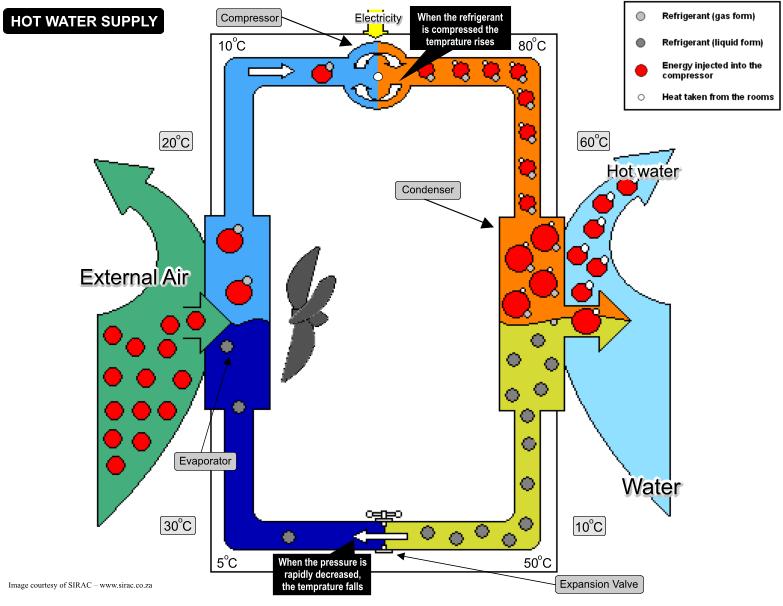
By manipulating the pressure of refrigerant, heat pumps move energy from one place to another.  Sometimes the energy is low-grade, like cold air.  But the heat pump turns it into high-grade energy by moving and concentrating it.

By manipulating the pressure of refrigerant, heat pumps move energy from one place to another. Sometimes the energy is low-grade, like cold air. But the heat pump turns it into high-grade energy by moving and concentrating it.

Heat pumps take advantage of a funny loophole in physics: phase change.  Phase change happens when any substance goes to a higher or lower energy level, for instance:

  • water turning to ice
  • perfume evaporating into the air
  • steel melting

Between the three phases, from lowest- to highest-energy level: solid-liquid-gas, a tremendous amount of energy is moved around.  With something like steel it’s easy to picture the energy required to make the steel go from a solid to a liquid.  The heat that goes into solid steel is energy that is used to drive the phase change to liquid.  Oddly, a substance can remain the same temperature while either absorbing or releasing large amounts of energy if the substance is going through a phase change.  Consider water.  You can have 32 deg F water and you can have 32 deg F ice.  When ice melts it absorbs a lot of energy from its environment, but it doesn’t warm up; it just changes phase.  In the other direction, liquid water can turn to ice, giving up a lot of energy in order to do so, but without getting any colder.

Engineers, maybe it was  Trane, the inventor of the modern air conditioner, figured out a way to manipulate phase change by forcing a substance to condense at a temperature when it would normally be a gas.  That’s kind of like turning 50 degree water into ice.  Some substances are more easily manipulated in this way, and will phase change at temperatures comfortable to humans.  These are the refrigerants.  There are a lot of different refrigerants and some of them are really bad for the environment, notably thinning out the ozone layer to the point that it’s pretty well swiss-cheesed. (On a side note, one of Nik’s clients told us last night that by pure, dumb luck humans avoided a very rapid extinction when Dupont decided to use chlorine in refrigerants instead of bromine.  They act and cost the same, but Bromine would have utterly destroyed the ozone in a couple of years, making the Earth uninhabitable for most plants and animals.)

Here’s the refrigerant cycle in a nutshell, and in 5th grade vocabulary.  I always think of physics in terms that I grasped when I was in 5th grade.  The refrigerant, which is normally gas at room temperature and above, starts as a gas.  It gets pumped into a compressor, which is the part of the whole system that uses big electricity, where it gets squeezed until it turns into a liquid.  Substances phase change at a given temperature and pressure.  If you change the pressure you can get the stuff to phase change at an odd temperature.  That’s the whole trick about heat pumps.  The liquid is pumped to an evaporator where it’s allowed to turn back into a gas, thereby absorbing a lot of heat (usually out of the air, but sometimes water).  When the refrigerant evaporates into a gas it cools air (or water) around it.  The warm, gaseous refrigerant is pumped back to the compressor where it goes through all that squeezing again.  It’s a cycle.

The way I’ve described it, the system is doing cooling.  However, the whole process can be reversed and then the system becomes a heater.  That’s what a heat pump is: a reversible air conditioner.  When you reverse the flow of the refrigerant through the compressor the refrigerant goes into the house as a gas.  Gaseous refrigerant condenses, giving up heat to the air (or water).  Viola!  a heater instead of an air conditioner.  In cooling mode, the condensing happens outside, “ejecting” heat to the back yard; in heating mode the heat is “ejected” inside the house.  In heating mode, energy (or heat if you prefer to think of it that way) is absorbed from outdoors and moved into the house; in cooling mode energy is absorbed from within the house and moved to the back yard.  Refrigerants and compressor are just a way of moving energy around.

Zen Heat Pumps

Doublespeak bullshit. This ad for Zen Heat Pumps is suggesting heat pumps are free AND spiritual.

And that is how heat pumps got their reputation as being “free heat”.  The energy that heats your house is indeed energy that came from outdoor air or ground water.  Even at low temperatures air holds enough energy to heat a home.  Of course, you need a lot of air to do that, and the heat pump uses a lot of electricity to make it happen.  It’s kind of like getting something for free but you have to pay the shipping.  Heat pumps also have a reputation as being “renewable” because the heat is energy that is supplied by the planet, but again you have to use a lot of electricity to get that heat, and since most electricity is not renewably generated it’s misleading to say so.  Nonetheless, it is a neat trick, and with recent improvements to heat pumps it works even in Vermont!
Posted by: Li Ling Young | March 1, 2013

Natural Gas

Because little about this house had been changed since it was built 60 years ago, we had the good fortune that some of our energy decisions were made easy for us.  If the house had already been hooked up to the natural gas pipeline, which probably came through this neighborhood in the 1980’s, I don’t think Nik and I would have ever questioned what our primary fuel would be.  But because the house was still using fuel oil for heating, we got to choose whether to start using a cheaper, cleaner, more convenient fuel that burns more efficiently.

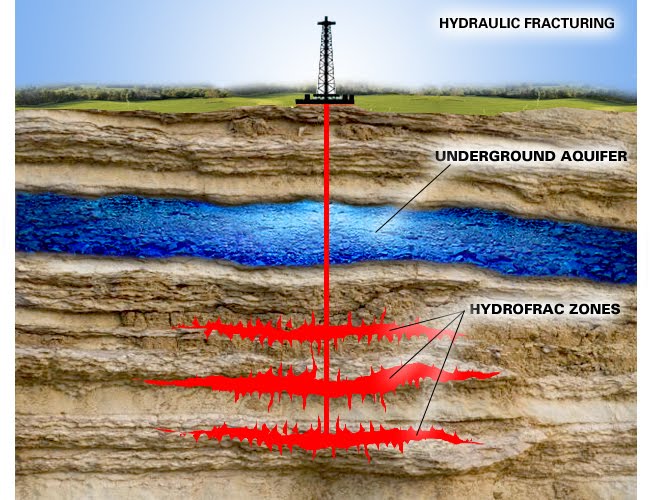
Any natural gas you use now is supporting fracking, with it's drilling, polluted aquifers and earthqakes.

Any natural gas you use now is supporting fracking, with it’s drilling, polluted aquifers and earthqakes.

As attractive as natural gas is, it comes with a host of ethical baggage.  We decided no to natural gas, and here’s why…

  • Natural gas is not renewable, and so is nothing more than a diversion on the way to beating climate change and repositioning our economy based on clean energy
  • The current low price of natural gas comes at the expense of polluted drinking water wells in other parts of the country
  • The natural gas supplier charges $17/month to be hooked up to the gas network, money I’d rather spend making my home more efficient

In a recent blog entry by Alex Wilson, Vermont’s Grandaddy of green buildings, Alex makes these further points

  • The cost of natural gas is artificially depressed because of a lack of facilities to compress it for transport overseas.  If all fifteen planned liquid natural gas facilities come on line the price pressure on natural gas will be tremendous.
  • As a relatively new technology, hydrofracturing for natural gas is poorly regulated and the natural gas industry is not transparent about what kinds of chemicals it uses, leaves in the ground and pumps out for “disposal”.
  • Depletion of natural gas wells may be much more rapid than anyone is expecting, which will leave a tremendous amount of infrastructure dependent on a dwindling resource.  (I would add that all the resources that went into building natural gas electricity generating plants could have been used in making our buildings and vehicles more energy efficient, a far better way to meet our energy needs.)
  • Unintentional, unreported leaks of methane gas could mean that the impact of natural gas on climate change is much worse than is widely understood.
  • Perhaps the real benefit of the current natural gas situation is not that we’ve found energy salvation, but that the economics of natural gas are forcing the closure of coal fired power plants.  By the time we figure out natural gas isn’t the fuel of the future, at least we won’t be falling back on coal.

Of course all of that would be irrelevant if we didn’t have the option of a better fuel.  Solar electricity gives us a real alternative to fuel oil, natural gas and coal-powered electricity.

Posted by: Li Ling Young | February 24, 2013

Demand Recirculator (not)

Nik has had it with how long it takes the hot water to reach our en suite bathroom.  Since I practice my always-on-the-cold-side approach to water use, I’m not much bothered by it.  But poor Nik has to shave, and in general has better hygiene than I do, so we’re going to do something about that wait.

A little pump under the farthest sink can deliver hot water to the sink fast without wasting water.

A little pump under the farthest sink can deliver hot water to the sink fast without wasting water.

Knowing how much I like to shop, Nik authorized me to buy a demand recirculator for our bathroom.  I’ve been recommending these to people for years.  Finally I get one of my own!  The product is called the Hot Water D’Mand Kontrol System and here is how it works:

  1. A small pump is installed under sink
  2. The pump connects the hot pipe to the cold pipe
  3. A button next to the sink activates the pump
  4. The pump pulls water out of hot pipe and sends it to the water heater via the cold pipe
  5. A temperature switch in the pump turns it off when the hot water arrives
  6. Hot water arrives at the sink within a couple of seconds of pushing the button; no water is wasted down the drain

The main benefit of these things is that no water runs down the drain while you’re waiting for the hot water to arrive, and of course the hot water arrives at the tap much faster than it otherwise would.  Saving water is great for the planet and we people, and there are big energy implications to wasting water, so save whenever possible.  But in terms of household energy, a demand recirculator has a very small impact.

Since it was a Sunday I started my shopping at the manufacturer’s website.  The Hot Water D’mand System is made by Advanced Control Technologies.  There I discovered that the D’mand comes in several sizes.  You want to get the smallest one that will do the job because an oversized pump will use more energy than you need.  The one that’s right for us is about $520.  Ack!  That’s a lot more than I was expecting.  As much as I wanted one of these things in my house I had to question what I’d be getting for $520 (plus we’d have to install an outlet under the sink for the pump).

I had Nik measure the amount of water in the pipe between the water heater and the sink.  He ran the water into a pitcher until it ran warm and measured half a gallon.  That’s pretty low, which means the sink isn’t really that far from the tank.  The wait arises from the low flow fixture at the sink.  Since it only flows at about .5 gallons a minute, it takes a long time for the pipe to empty of the cold water.  (All is relative; I’ve heard of waits much longer than that.)

With a potential savings of only half-a-gallon per hot water draw, and probably no more than a couple of serious hot water draws a day at that sink, that $520 loomed large.  Looking only at the cost of the saved water, it would take 135 years to save enough water to cover the cost of the D’Mand system.  That’s an extremely simplified way of looking at it and ignores the time value of money, water cost inflation, water heater fuel savings and pump energy, not to mention the whole point of getting this thing: convenience.  Nonetheless, it does put into perspective the cost.  I decided to check out other ways to make Nik happy in the bathroom.

I was looking for a residential version of a system I know of that goes on a continuously-circulating hot water system.  This device is similar to electric heat tape pipe wrap, but with controls that make sure it only adds energy to the water when necessary.  Nothing like that exists for residential systems, plus my idea would require a flow meter to turn the heat tape on and that would add a whole lot of complication and cost.  In the end I had to concede that the cheapest/simplest way to get instant hot water at the tap is to put a very small electric on demand water heater under the sink.  The one I like best is the Stiebel Eltron Mini 2.  It’s rated at .32 gallons per minute, but can handle higher flows if you’re willing to have water cooler than 120 deg F.  It costs $169.

The obvious drawback to this approach is that the little water heater will use electricity to heat the water (whereas the D’Mand only uses electricity to pump water around).  Will this little water heater add much to our water heater bill?  Remembering that the most heating it would have to do is .5 gallons at a shot, the cost to use this approach is 1.24 cents per draw, or $9.05 a year.  It also saves wasted water, so taking out the $3.84 for water savings, that’s just $5.21 a year.  All told, I think this a better approach.

Naturally, it’s more complicated than that.  I don’t know whether this water heater can be used in line with another water heater.  If not, we’d have to put a temperature gauge on the hot water pipe that would turn the Mini off if the water in the pipe is already hot.  That adds more cost.  Also, putting the water heater under the sink means we’d still have to wait for hot water (and waste water down the drain) at the shower.  To take care of both we’d need a a bigger Mini and we’d have to put it farther from the sink, which would entail a stranded-water inefficiency.  More to find out, more decisions to be made.  Hope to have an interesting update in a little while.

« Newer Posts - Older Posts »

Categories